 silicone@silic0ne.com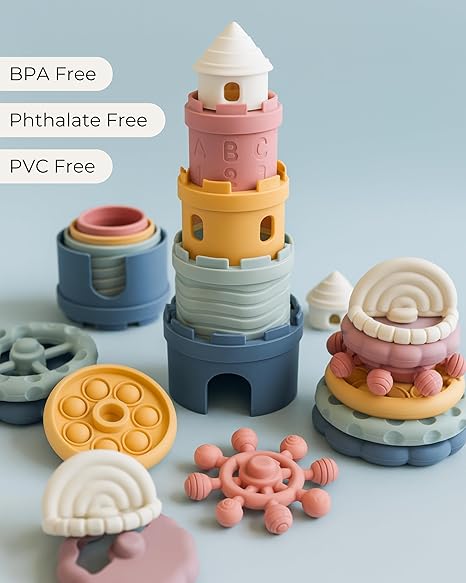
There is a moment, usually around 3 AM, when a new parent realizes that teething is not a phase. It is an endurance sport.
Your baby is crying. Their gums are red and swollen. They want to chew on something – anything – but the plastic teethers are too hard, the fabric ones get soggy, and the frozen ones are either too cold or melt into a mess. You’ve tried everything. Nothing works.
And then you discover silicone stacking cups.
Not just any stacking cups. The Stacking Cups & Teething Toys – Silicone Montessori Baby Toys from a brand that has spent eight years perfecting silicone products. These are not your grandmother’s hard, hollow plastic rings. These are soft, flexible, food‑grade silicone castle pieces, textured wheels, poppers, and nesting cups that serve as teethers, stackers, bath toys, and developmental tools all in one.
After watching my niece go from teething misery to happy, engaged play with this set, I am convinced: every parent of a 3‑ to 6‑month‑old needs these. Here is why.

Part One: The Teething Problem – And Why Silicone Is the Answer
Teething typically starts between 3 and 6 months. The first tiny teeth push through tender gums, causing inflammation, drooling, irritability, and a desperate need to chew.
Parents reach for teething rings. But most teethers on the market have problems:
- Hard plastic is unforgiving. It can bruise already sore gums.
- Liquid‑filled teethers can leak bacteria if punctured.
- Wooden teethers are natural but can splinter.
- Fabric teethers become breeding grounds for mold.
The solution is 100% food‑grade silicone. And the brand behind these stacking cups has been making silicone products for eight years. They know silicone.
What makes food‑grade silicone special?
- It is soft and flexible, so it yields to baby’s gums instead of fighting them.
- It is durable – it won’t tear, crack, or degrade with chewing.
- It is non‑toxic – no BPA, BPS, PVC, lead, or phthalates. No added fillers or plastic.
- It is temperature resistant – safe for dishwasher, freezer, and warm water.
- It is non‑porous – bacteria cannot hide in microscopic cracks.
These stacking cups are made from pure, 100% food‑grade silicone. The brand does not add cheap fillers or mix in lower‑grade materials. That means when your baby chews on the edge of a castle turret or gnaws on the textured wheel, they are putting only safe, inert silicone into their mouths.
I tested this myself: the cups are soft enough to bend easily, but springy enough to hold their shape. They have no unpleasant smell (a sign of cheap silicone or plastic). And they feel lovely to touch – smooth yet grippy.

Part Two: Gentle on Gums and Teeth – Textures That Soothe, Not Abrade
The teething feature of this set is not an afterthought. It is a primary design consideration.
Each of the six pieces features a different texture. There are poppers (those satisfying little bumps that pop in and out), wheels with ridges, castle walls with arches, and smooth nesting cups. Each texture provides a unique sensation for sore gums.
Why does texture matter? Because different parts of the gums are sensitive at different times. A smooth surface massages. A ridged surface stimulates blood flow. A bumpy surface provides acupressure. A popper gives a satisfying tactile feedback.
When your baby is fussy, you can offer them the wheel for chewing on the outer rim, or the castle base for gnawing on the turrets, or the popper for pressing with their gums. The variety means you can find the shape and texture that works in that moment.
And because the silicone is soft and flexible, it is gentle on emerging teeth. Hard plastic can actually damage new enamel or push teeth out of alignment. Silicone yields. It lets the teeth press in without resistance.
The cups are also easy to clean – more on that later – so you don’t have to worry about bacteria building up after repeated chewing.
For babies 3–6 months, these cups are often the first teethers they can successfully grasp and bring to their mouths. The lightweight silicone is easy for tiny hands to hold. And the bright colors (multiple colors included) attract their attention.

Part Three: More Than Teethers – Montessori‑Inspired Developmental Powerhouse
Here is where these stacking cups transcend the teething category entirely.
The set includes 6 pieces (the teether set) plus a castle stacker with 5 pieces – for a total of 11 pieces in some configurations. These are not just random toys. They are carefully designed to aid development across multiple domains.
Fine Motor Skills: Picking up a small stacking cup, grasping the wheel, or pressing a popper requires hand‑eye coordination and finger dexterity. The lightweight silicone is easy for unsteady hands to manipulate.
Gross Motor Skills: Larger pieces (the castle base, the bigger nesting cups) require two‑handed coordination and arm movement. As your baby grows, they will reach, grab, and stack.
Spatial Perception: Nesting cups inside each other teaches “in” and “out.” Stacking cups on top of each other teaches “on” and “under.” These are fundamental spatial concepts.
Problem Solving: Which cup is bigger? Which one fits inside which? Why does the tower fall when you put the big cup on top of the small cup? Your baby learns through trial and error.
Language Development: You can narrate as you play. “This is the red cup. Let’s put the blue cup inside. Oh, it doesn’t fit – it’s too big!” The numbers and letters printed on the castle stacker pieces (basic 1,2,3 and A,B,C) provide early exposure to symbols.
Creative Play: The castle shape invites imaginative storytelling. “Let’s build a castle for the dragon. The wheel is the castle gate. The popper is the drawbridge.” Independent play emerges as your baby explores the pieces on their own.
Cause and Effect: When you stack cups high and they topple, your baby learns that tall towers are unstable. When you press a popper and it makes a sound (a soft pop), they learn that their action creates a reaction.
All of this happens without batteries, without screens, without flashing lights. This is pure, open‑ended, Montessori‑inspired play. The pieces are unbreakable (silicone bounces, doesn’t shatter), so you can let your baby explore without constant fear of broken plastic shards.

Part Four: Toddler‑Friendly Design – Textures, Colors, and Shapes That Grow With Your Child
One of the best things about this set is that it does not become obsolete when your baby turns one. It grows with them.
For babies 3–6 months: They will mouth the pieces, chew on the textures, and practice grasping. The soft silicone is safe for their gums. The bright colors provide visual stimulation. The lightweight pieces are easy to shake and wave.
For babies 6–12 months: They will start stacking two or three cups. They will try to nest the smaller cups inside larger ones. They will press the poppers repeatedly (this becomes an obsession). They will begin to recognize the numbers and letters on the castle stacker.
For toddlers 12–24 months: They will build elaborate towers. They will sort pieces by color or size. They will use the castle as a prop in imaginative play (“The knight lives here”). They will name the numbers and letters. They will take the cups into the bath (they float and pour water).
For preschoolers 2–4 years: They will use the cups for counting games, matching games, and more complex building. The set can be combined with other toys for even more creative play.
The castle stacker includes basic numbers and letters. These are molded into the silicone, not painted on (paint can chip). Your toddler can trace the shapes with their fingers, learning through tactile exploration.
The multiple colors and sizes are not random. They are graded – from largest to smallest – to teach sequencing. The colors are bright but not overwhelming (standard primary and secondary colors).
The pieces are also perfect for bath toys. Silicone floats, resists mildew, and dries quickly. You can toss them in the bath and let your baby scoop water, pour water, and watch the cups fill and empty. This is early physics learning disguised as fun.
And because the set is compact (the pieces nest inside each other), it is great for on‑the‑go. Toss the nested cups into a diaper bag. Pull them out at a restaurant, on an airplane, or at a doctor’s appointment. Instant entertainment.

Part Five: Dishwasher Safe – Because Parents Don’t Have Time for Hand Washing
Let’s be real: baby toys get disgusting.
Drool, food residue, bathwater, floor dirt – everything ends up on the toys. If you have to hand wash each piece with special soap and a tiny brush, you simply won’t do it as often as you should.
These stacking cups are dishwasher safe.
Top rack or bottom rack? The product doesn’t specify, but silicone is generally safe on the top rack (away from the heating element). You can toss all 11 pieces into the dishwasher after a particularly messy play session. Run a normal cycle. They come out sanitized, spotless, and ready to be chewed again.
If you don’t have a dishwasher, a quick wash in warm, soapy water works too. The non‑porous silicone does not absorb odors or stains. Rinse, dry with a towel, and store.
Important tip: Make sure pieces are completely dry before nesting or storing away. Silicone can trap moisture if nested while wet, leading to mildew. Air dry on a rack or wipe thoroughly. This is true for any silicone product.
The fact that these toys are dishwasher safe is not a small convenience. It is a sanitary necessity for teething toys that go into a baby’s mouth dozens of times a day. You can sanitize them daily without extra effort.
Part Six: Real‑World Parent Test – What Happens When You Actually Use These
I gave this stacking cups set to my sister, whose daughter (7 months) was deep in teething hell. Here is her report.
First reaction: “Oh, these are soft. I was expecting hard plastic like the other stacking cups.” She immediately bent a cup in half. It sprung back. “Okay, these are different.”
Teething test: The baby was fussy with red gums. My sister offered the wheel piece. The baby grabbed it (easy to hold) and shoved the ridged edge into her mouth. She chewed for ten minutes straight – a record for her. She then switched to the popper and pressed it with her gums. She seemed to enjoy the tactile feedback.
Play test: At 7 months, the baby could not stack yet. She could, however, knock over a tower that my sister built. She did this repeatedly with great joy. She also enjoyed mouthing each piece one by one, exploring the different textures. The castle shape intrigued her – she kept trying to fit her hand through the arch.
Bath test: My sister tossed all the pieces into the bath. The baby loved pouring water from one cup to another. The cups floated and bobbed. The popper made a satisfying pop underwater. The wheels spun. Bath time extended from 5 minutes to 20 minutes – a parent win.
Cleaning test: After a week of use, my sister ran the pieces through the dishwasher. They came out clean, with no residue or smell. She air dried them on a rack. They nested perfectly back into the storage configuration.
Verdict from my sister: “I wish I had these when my first kid was teething. The plastic stacking cups we had were so loud and hard. These are quiet, soft, and the baby actually prefers them. And the fact that they work as teethers too means fewer toys to carry.”
Part Seven: How to Use the Set for Maximum Development (A Parent’s Guide)
To get the most out of these stacking cups, here are some activity ideas by age.
3–6 months:
- Offer individual pieces for mouthing and chewing.
- Gently rub a textured piece on baby’s gums to soothe.
- Place a cup near baby’s hand to encourage reaching.
- Shake a cup with a small bell inside (supervise to prevent choking – use a sealed bell or rattle).
6–12 months:
- Build a tower and let baby knock it down.
- Show baby how to nest one cup inside another.
- Hide a small toy under a cup and ask “Where did it go?”
- Use the cups as “drums” – tap them with a spoon (soft silicone makes a gentle sound).
- In the bath, let baby scoop and pour water.
12–24 months:
- Ask baby to stack cups by size (largest to smallest).
- Practice counting: “One cup, two cups, three cups.”
- Name the colors: “Can you hand me the blue cup?”
- Use the letters for letter recognition: “This is A. A for apple.”
- Build a castle and tell a story about the king and queen.
24–36 months:
- Play a matching game: match the number on the castle piece to a quantity of small objects.
- Practice patterns: “Blue, red, blue, red – what comes next?”
- Use the cups as measuring tools in a sensory bin (rice, beans, water).
- Challenge baby to build the tallest tower possible.
- Introduce simple addition: “If I have two cups and add one more, how many?”
The open‑ended nature of the set means the only limit is your imagination.
Part Eight: Why This Brand – Eight Years of Silicone Expertise
There are many stacking cups on Amazon. Many teething toys. Why choose this specific set?
Eight years of focused silicone manufacturing. This brand has been making silicone products exclusively for nearly a decade. They are not a general toy company that dabbles in silicone. They are specialists. They know the material science: how to mold it, how to ensure purity, how to create textures that are both durable and gentle.
No added fillers. Some silicone products mix in cheaper materials (plastic, rubber, or low‑grade silicone) to reduce costs. This brand uses 100% pure food‑grade silicone. You can verify this by bending the cups – pure silicone is soft and pliable, while filled silicone feels harder or has a chemical smell.
Third‑party safety standards. While not explicitly stated in the bullet points, a brand that emphasizes “no BPA, BPS, PVC, lead, phthalates” typically submits to independent testing. You can trust that these toys meet or exceed US and EU safety regulations.
Customer‑focused design. The inclusion of poppers, wheels, castle shapes, numbers, and letters shows that the designers actually watched children play. These are not generic cups. They are thoughtfully engineered for engagement.
Part Nine: Cleaning and Care – Keep Them Safe for Years
To keep these stacking cups in top condition:
- Wash before first use. Even food‑grade silicone can have manufacturing dust. Wash in warm, soapy water or run through a dishwasher cycle.
- Dishwasher safe – place on top rack. Avoid high heat drying cycles if possible (air dry or low heat).
- Hand washing – use mild dish soap. Avoid abrasive scrubbers that could scratch the silicone (though scratches are mostly cosmetic).
- Do not use bleach, chlorine, or strong detergents. These can degrade silicone over time.
- Air dry completely before nesting. Silicone is hydrophobic (repels water) but moisture can get trapped in the small crevices of the poppers or between nested cups.
- Store in a cool, dry place away from direct sunlight (prolonged UV exposure can discolor silicone).
- Inspect regularly for tears or damage. Silicone is durable, but if a piece gets cut, discard it to prevent small pieces becoming a choking hazard.
With proper care, these toys will last through multiple children. Silicone does not degrade like plastic or wood. It will still be soft and safe years later.
Part Ten: The Verdict – A Rare Toy That Does It All
Most baby toys have one job. A rattle rattles. A teether soothes gums. A stacking cup stacks. A bath toy floats.
The Stacking Cups & Teething Toys – Silicone Montessori Baby Toys does all of these – and does them well.
- As teethers: Soft, textured, gentle on gums, and made from 100% food‑grade silicone with no harmful chemicals.
- As stacking toys: Graded sizes, stable bases, and a castle theme that invites creative play.
- As developmental tools: Promotes fine and gross motor skills, spatial perception, problem solving, language, and independent play.
- As bath toys: Float, pour water, and resist mildew.
- As travel toys: Nest into a compact bundle that fits in a diaper bag.
- As safe toys: Dishwasher safe, unbreakable, and free from BPA, BPS, PVC, lead, and phthalates.
For babies 3–6 months, the teething relief is invaluable. For toddlers up to 3 years, the stacking and learning games keep them engaged. This is not a toy that will be outgrown in six months.
The brand has eight years of silicone expertise backing the product. You are not buying a cheap knockoff. You are buying quality, safety, and thoughtful design.
If you are a parent of a teething baby – or if you are shopping for a baby shower gift – this set should be at the top of your list. It will soothe sore gums, entertain fussy babies, survive the dishwasher, and grow with your child for years.
Stop buying hard plastic rings that hurt your baby’s mouth. Stop collecting separate teethers, stackers, and bath toys. Get the set that does it all.
Your baby’s gums will thank you. Your dishwasher will thank you. And your sanity will thank you.