 silicone@silic0ne.com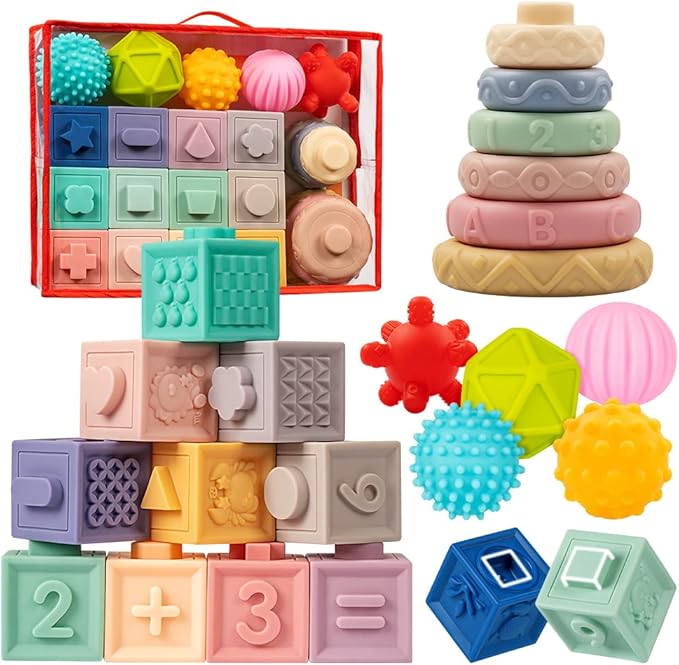
There is a moment, usually around the 6‑month mark, when your baby transforms.
Suddenly, they are not just a sleepy, wiggly bundle. They are reaching for things. Grabbing. Chewing. Trying to stack. Trying to knock down. Their eyes light up when they see bright colors. Their hands explore every texture. And their mouth – always their mouth – investigates everything.
You look at your collection of baby toys and realize: the rattles are boring. The plastic keys are too hard. The stuffed animals don’t do anything. You need something that grows with them. Something that teaches colors, shapes, numbers, balance, and fine motor skills. Something that soothes sore gums. Something that squeaks. Something that can be thrown, squeezed, stacked, and nested.
You need the 3 in 1 Soft Baby Toy Set – 24 pieces of Montessori‑inspired magic designed for babies 0‑3‑6‑9‑12 months and beyond.
I’ve watched a 7‑month‑old go from frustrated fussing to engaged, happy play with this set. Here is why it belongs in every nursery, diaper bag, and playroom.

Part One: What’s in the Box? A Complete Developmental Toolkit
Let’s start with the sheer value of this bundle.
The set includes 24 individual pieces:
- 12 different colored building blocks – soft, stackable, connectable
- 6 soft stacking rings – classic ring stacker, but squeezable
- 5 squeeze sensory balls – each with a different texture and squeaker
- 1 convenient storage bag – mesh or fabric, for easy cleanup and travel
That is not a toy. That is a toy library in one box.
Most baby toys come as single items. You buy a ring stacker. You buy separate blocks. You buy a ball. You buy teethers. You spend three times as much money and end up with a messy pile of mismatched pieces.
This set consolidates everything. The blocks stack and connect. The rings stack on a post (or on each other). The balls can be rolled, squeezed, and chewed. All the pieces work together or separately. And when playtime is over, everything fits into the storage bag – no lost pieces, no clutter.
The recommended age range is 0‑3‑6‑9‑12 months and even up to 18 months‑2 years. That means this set will not be outgrown in six months. It evolves with your child’s developing skills.

Part Two: Montessori at Home – Learning Colors, Shapes, Numbers, and Balance
The Montessori method emphasizes hands‑on, self‑directed learning with real objects. These toys are a perfect fit.
Colors: The 12 blocks come in a rainbow of colors – red, orange, yellow, green, blue, purple, pink, and more. As you play, you can name the colors. “Can you hand me the blue block?” “This ball is yellow.” By 9 months, babies begin to recognize color differences. By 18 months, they can start sorting.
Shapes: The blocks are squares. The stacking rings are circles. The balls are spheres. Your baby will learn the difference through touch and sight. The blocks also have numbers and basic math symbols (+, -, =) embossed or printed on them – early exposure to numeracy.
Counting: With 12 blocks and 6 rings, you can count together. “One, two, three blocks.” “How many rings?” Even before they can speak, babies absorb the rhythm of numbers.
Balance and spatial reasoning: Stacking blocks requires careful hand placement. If you put a big block on top of a small one, the tower falls. Your baby learns cause and effect. Stacking rings on a post teaches size ordering – the largest ring goes first, then smaller ones.
Fine motor skills: Grasping a small block, fitting a ring onto a post, squeezing a ball – all of these actions strengthen the tiny muscles in your baby’s hands and fingers. This is the foundation for later skills like holding a crayon, using scissors, and writing.
Hand‑eye coordination: Your baby sees the block. Their hand reaches for it. Their eyes guide the hand. This basic skill is practiced every time they play.
Cognitive ability: Problem‑solving emerges naturally. “Why won’t this block stay on top? Oh, I need to put the flat side down.” “How do I make the ball squeak? I squeeze it.”
Language development: As you narrate play, your baby hears words for actions (“stack,” “fall,” “squeeze”), objects (“block,” “ring,” “ball”), and concepts (“up,” “down,” “in,” “out”).
All of this happens without screens, without batteries, without flashing lights. Just pure, open‑ended play.

Part Three: Sensory Exploration – Textures, Sounds, and Squeezability
Babies learn through their senses. This set engages all of them.
Touch: The blocks are soft but firm – not hard plastic that hurts when thrown. The rings are smooth and flexible. The balls have different textures: some are bumpy, some are ridged, some are smooth. Your baby will explore each texture with their fingers and their mouth.
Sound: Squeeze the sensory balls, and they make a squeaking sound. Not loud or startling – a gentle, satisfying squeak that teaches cause and effect. Your baby will squeeze, hear the squeak, and squeeze again. This is early auditory feedback.
Sight: Bright, contrasting colors attract your baby’s attention. The variety of shapes (blocks, rings, spheres) provides visual interest. You can also use the blocks for color matching games as your baby gets older.
Proprioception (body awareness): Lifting a block, stacking rings, throwing a ball – all of these actions help your baby understand where their body is in space and how much force to use.
The diverse stacking sensory aspect means your baby can build towers, make piles, line up blocks, or simply chew on a ring. There is no wrong way to play.

Part Four: Safe Teething Material – BPA Free, Non‑Toxic, and Soft on Gums
Let’s address the elephant in the nursery: teething.
Between 3 and 12 months, your baby’s gums are swollen, red, and painful. They will chew on anything – your fingers, the crib rail, a遥控器. You need teethers that are safe, soft, and easy to clean.
These toys are made from BPA‑free, non‑toxic, high‑quality material. The exact material is not specified, but the description emphasizes softness and durability – likely food‑grade silicone or a soft thermoplastic elastomer (TPE). Both are free from harmful chemicals like phthalates, lead, and PVC.
Why these are great teethers:
- Soft and flexible – gentle on gums, unlike hard plastic.
- Small holes in each piece (mentioned in the description) allow baby to bite down without creating suction that could hurt their gums. The holes also let water drain during washing.
- Squeaky balls provide auditory feedback when chewed – babies love the combination of texture and sound.
- Multiple shapes – rings, blocks, balls – give different angles for chewing. A ring can reach back molars. A block can be gnawed on a corner. A ball can be squeezed and chewed simultaneously.
The set is designed for babies 0‑3‑6‑9‑12 months, which covers the entire teething window. You won’t need to buy separate teethers.
Safety note: Always inspect toys for damage before giving them to your baby. If a piece tears or breaks, discard it immediately to prevent choking hazards. With normal use, these toys should last through multiple children.

Part Five: Why 24 Pieces? The Power of Quantity and Variety
Some parents might think: “Do I really need 24 pieces?”
Yes. Here is why.
Babies at 6‑12 months have short attention spans. They might play with a block for 30 seconds, then drop it and reach for a ring. Having many pieces means you can rotate toys without losing engagement. When one toy loses its novelty, another is waiting.
The 12 blocks allow for complex stacking. With only 4 blocks, a tower is limited. With 12, your toddler can build a castle. The blocks also connect (they likely have interlocking nubs or are simply stackable) for even more possibilities.
The 6 stacking rings are more than a typical ring stacker. Most come with 4 or 5 rings. Six rings teach finer size discrimination.
The 5 sensory balls provide variety in texture and squeak pitch. Each ball may sound slightly different, keeping your baby curious.
The storage bag is not an afterthought. It encourages clean‑up habits early. When playtime ends, you and your baby can put the pieces back in the bag. This teaches responsibility and reduces lost pieces.
For parents, the bag means you can grab the entire set and go – to grandma’s house, to a restaurant, on a plane. No more hunting for missing rings under the couch.
Part Six: Real‑World Play – What 6, 9, and 12 Months Look Like
Let’s break down how this set grows with your baby.
0‑3 months (newborn to 3 months): At this age, babies have limited vision (black/white/high contrast) and cannot grasp intentionally. You can place the brightly colored balls or rings near them for visual tracking. The soft texture is safe if they accidentally mouth it. But primarily, this set is for you to use as a visual and auditory stimulant.
3‑6 months: Your baby can now reach and grasp. They will grab a ring and shake it. They will bring a block to their mouth. They will squeeze a ball (maybe not hard enough to squeak yet). The teething relief begins. You can prop up a tower for them to knock over – they love this.
6‑9 months: Sitting independently. Your baby can now stack two or three blocks. They can place rings on a post (if you have the post – the set includes rings; you may need to use a separate stacker base or just stack them on the floor). They will intentionally squeeze the balls to make them squeak. They will sort pieces by color or size with your help.
9‑12 months: Crawling and pulling up. Your baby can carry a block from one place to another. They can build towers of 4‑5 blocks. They can identify colors when asked (“Where is the red block?”). They will engage in simple pretend play – “This block is a phone. Hello?”
12‑18 months: Walking. Your toddler can now build elaborate structures. They can count the blocks. They can match numbers to quantities. The squeaky balls become throw toys (soft and safe for indoor play). The stacking rings can be used for nesting or sorting.
18‑24 months: Language explosion. Your toddler can name colors, count to 12, and recognize basic numbers and math symbols on the blocks. They can follow multi‑step instructions (“Put the blue ring on top of the red block”). The set becomes a math manipulative.
This is not a toy that will be donated after a few months. It earns its place in your home for years.
Part Seven: Cleaning and Care – Easy Enough for Tired Parents
Baby toys get dirty. Drool, food puree, floor dust, bathwater – everything ends up on the toys. If cleaning is hard, you won’t do it enough.
These toys are recommended to clean with high‑temperature water. Boil water, let it cool slightly, then wash the toys. High heat kills bacteria without harsh chemicals.
Step‑by‑step cleaning:
- Before washing, stick the hole – Each toy has a small hole (for air release and teething). If you submerge the toy without sealing the hole, water will get inside and may not dry completely. Use a toothpick, a pin, or your finger to plug the hole while washing. Or simply wash the surface without submerging.
- Wash with hot, soapy water – Use mild dish soap. Rinse thoroughly.
- Squeeze out water inside – If any water entered the hole, squeeze the toy gently to expel it.
- Put the hole upward – Place the toy with the hole facing up so gravity helps water drain and air circulates.
- Dry in the sun – Sunlight is a natural disinfectant. Place the toys in direct sunlight until fully dry. This may take a few hours.
- Ensure complete dryness before storing – Any trapped moisture can lead to mold or mildew. The storage bag is breathable (likely mesh), but still, dry thoroughly.
Dishwasher? The instructions don’t specify, but if the toys are 100% silicone or TPE, they are likely top‑rack dishwasher safe. However, the high heat of a dishwasher drying cycle might degrade some materials. Hand washing with hot water is safer.
Do not use bleach, strong detergents, or abrasive scrubbers. They can damage the soft material and leave chemical residues.
With proper care, these toys will remain hygienic and safe for years.
Part Eight: Perfect Gift for Toddlers – Birthday, Christmas, Thanksgiving
If you are shopping for a baby shower, a first birthday, or a holiday gift, this set is a winner.
Why it makes a great gift:
- Value: 24 pieces for the price of a single toy from a boutique brand. Parents appreciate quality without overspending.
- Longevity: Usable from birth to 2+ years. Not a “use for three months and outgrow” toy.
- Developmental: Montessori‑aligned. Grandparents who want to give an “educational” gift will feel good about this.
- Convenient storage: The included bag means the gift is self‑contained – no gift wrap needed (or wrap the bag).
- Unisex: Bright colors and neutral themes work for boys and girls.
- Safe: BPA free, non‑toxic, soft – no sharp edges or small parts that detach (the pieces are solid).
The packaging is likely a box or the storage bag itself. You can present it as is or add a ribbon.
For your own child, this set is a no‑brainer. For someone else’s child, it is a thoughtful, practical, and appreciated gift.
Part Nine: How to Maximize Play – Tips for Parents
You have the toys. Now what? Here are some activity ideas by age.
For babies 3‑6 months:
- Hang a ring from a play gym for batting practice.
- Roll a ball gently toward baby to encourage reaching.
- Offer a block for mouthing (supervise).
- Stack three blocks and let baby knock them down.
For babies 6‑9 months:
- Practice “in and out” – put blocks into a container, then dump them out.
- Build a tower and count the blocks as you add them.
- Hide a ball under a ring and ask “Where did it go?”
- Squeeze the ball to make it squeak, then hand it to baby to try.
For babies 9‑12 months:
- Sort blocks by color into piles.
- Use the rings to teach “big” and “small.”
- Roll a ball back and forth – early turn‑taking.
- Line up blocks like a train.
For toddlers 12‑18 months:
- Stack blocks as high as possible. Count as you go.
- Use the math symbols on blocks for very simple sums (1 + 1 = 2).
- Name the colors and ask toddler to point.
- Create patterns: blue, red, blue, red – what comes next?
For toddlers 18‑24 months:
- Build a “castle” and tell a story.
- Play “I spy” with colors.
- Use the balls for gentle bowling (knock over block towers).
- Practice counting to 12 with the blocks.
The key is to follow your child’s lead. If they want to stack, stack. If they want to chew, let them chew. The toys are open‑ended.
Part Ten: The Verdict – A Rare Toy Set That Delivers on Every Promise
The baby toy market is flooded with cheap, single‑purpose plastic junk. This 3 in 1 Soft Baby Toy Set is the opposite.
It is 3 toys in 1 – stacking blocks, stacking rings, and sensory balls – plus a storage bag. That is 24 pieces of high‑quality, soft, safe, Montessori‑inspired play.
It grows with your child from 0 to 24 months. It teaches colors, shapes, numbers, balance, fine motor skills, hand‑eye coordination, and problem‑solving. It soothes teething gums with soft, BPA‑free material. It squeaks, stacks, connects, and squeezes. It is easy to clean with hot water and sun dry.
And it comes in a convenient storage bag that keeps all 24 pieces together – no lost parts, no clutter, no stress.
For parents of a 6‑12 month old, this set is a lifesaver. For gift‑givers, it is a home run. For babies, it is endless hours of joyful, developmental play.
Stop buying separate teethers, blocks, rings, and balls. Get the all‑in‑one solution that does it all.
Your baby’s development – and your sanity – will thank you.