 silicone@silic0ne.com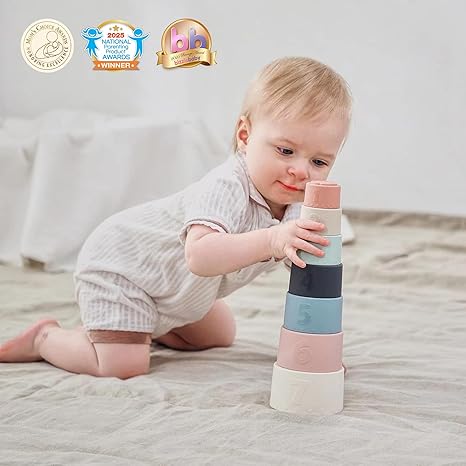
There is a certain magic that happens when a baby discovers stacking cups.
It usually starts around six months. You hand them a bright, lightweight cup. They turn it over, examine it, and immediately put it in their mouth. Then they drop it. You pick it up. They drop it again. You wonder if this is really “play.”
Then, one day, they put one cup inside another. Their eyes widen. They do it again. Then they stack one on top of another. The tower wobbles, falls, and they giggle. Suddenly, they are learning physics, spatial relationships, cause and effect, and fine motor control – all from a set of simple cups.
The Moonkie Stacking Cups Toy takes this classic concept and elevates it with 100% food‑grade silicone, thoughtful textures, bath‑ready holes, and a vibrant, number‑learning design. It is not just a toy. It is a teether, a bath toy, a sensory tool, and a developmental powerhouse for babies aged 6 months and up.
After watching my nephew go from a fussy teether to an engaged, focused stacker with this 7‑piece set, I am convinced: Moonkie has created the definitive stacking cup experience. Here is why.

Part One: The Innovative Design – More Than Just Cups
Most stacking cups are hollow plastic cylinders. They stack. They nest. That is about it.
Moonkie’s 7‑piece set is different. Each cup has been thoughtfully engineered with multiple layers of learning and sensory stimulation.
Seven distinct colors – red, orange, yellow, green, blue, purple, and pink – are not just visually appealing. They teach color recognition. By 9 months, babies begin to distinguish colors. By 18 months, they can name them. Playing with these cups gives you an easy way to say, “Let’s find the blue cup,” or “This is the yellow one.”
Different top patterns – each cup has a unique top rim pattern with “exquisite strokes.” This means the edge of each cup feels different to little fingers and mouths. Some might have wavy edges, others scalloped, others ridged. These patterns enrich your baby’s tactile sense. As they handle each cup, their brain processes the different textures, building neural pathways for sensory integration.
Numbers – the cups are printed with numbers, likely 1 through 7. This introduces early numeracy. You can count the cups as you stack them. “One, two, three…” By the time your toddler is 2, they will recognize the numerals.
Fine motor skills – stacking requires precision. Your baby must align the cup’s rim with the cup below. Nesting requires understanding of size gradients. Both actions strengthen the small muscles in the hands and fingers – the same muscles that will later hold a crayon, a fork, or a pencil.
The cups are also the perfect size for small hands. Not too big, not too small. Lightweight enough to lift, but sturdy enough to stay stacked.

Part Two: 100% Food‑Grade Silicone – Safe Enough to Chew, Durable Enough to Last
Let’s talk about materials, because this is where Moonkie truly stands out.
Many stacking cups are made of hard plastic – often polypropylene or polyethylene. These are generally safe, but they are hard. When a teething baby chews on hard plastic, it can bruise their gums. And if the plastic contains BPA, phthalates, or other additives, those chemicals can leach into your baby’s mouth.
Moonkie uses 100% food‑grade silicone. Not silicone mixed with fillers. Not silicone with a plastic core. Pure, premium silicone.
What does that mean for your baby?
- Soft and flexible – When your baby chews on a Moonkie cup, the silicone yields. It feels like a gentle gum massage, not a hard surface. This makes it an exceptional teething toy.
- Odor‑free – Cheap silicone often has a smell (like a new shower cap). Moonkie’s silicone is odorless. No unpleasant chemical scent.
- No harmful chemicals – Free from BPA, BPS, PVC, phthalates, lead, and other toxins. You can put these cups in your baby’s mouth with complete confidence.
- No fillers – Some brands add cheaper materials to reduce cost. Fillers can make silicone stiffer, less durable, or even toxic. Moonkie uses 100% pure silicone – no compromises.
The cups are also dishwasher safe (top rack) and easy to clean with warm, soapy water. Silicone is naturally non‑porous, so it does not harbor bacteria or mold. After a bath or a teething session, a quick wash and dry is all you need.
For parents who are paranoid about toxins – and let’s be honest, most of us are – the Moonkie stacking cups offer genuine peace of mind.

Part Three: Rich Textures – A Sensory Feast for Little Fingers and Gums
One of the most overlooked aspects of baby toys is texture. A smooth surface is boring. A variety of textures is engaging.
The Moonkie cups feature raised surrounding cup body textures. This means the outside of each cup is not smooth – it has bumps, ridges, or patterns that your baby can feel.
Why does this matter?
Tactile development: The sense of touch is one of the first to develop in utero. After birth, babies learn about the world by touching everything. Different textures send different signals to the brain, building a rich sensory map. When your baby runs their fingers over the raised patterns, they are learning about “rough” and “smooth,” “bumpy” and “flat.”
Teething relief: Textured surfaces provide excellent gum massage. A smooth teether just gets wet. A textured teether has ridges that can reach tender spots and apply gentle pressure. Your baby will naturally chew on the cup bodies, finding the texture that feels best on their sore gums.
Grip: The raised textures also help little hands hold the cups. Silicone can be slippery when wet, but the textures provide extra friction. This means fewer drops and less frustration.
Each of the 7 cups may have slightly different textures? The product description says “rich textures” and “raised surrounding cup body textures,” implying that the cups are not all identical. This variety keeps your baby curious. They will explore cup after cup, finding new sensations.

Part Four: Perfect Teether – Soft, Chewable, and Designed for Sore Gums
Teething typically begins around 4 to 7 months, with the first teeth (usually the bottom front incisors) pushing through. Symptoms include drooling, irritability, red gums, and a desperate need to chew.
Parents buy special teething rings. Some are liquid‑filled (risk of leaking). Some are hard plastic (risk of gum bruising). Some are wooden (risk of splinters). Many are single‑use – once the teething phase passes, the teether becomes useless.
The Moonkie stacking cups solve this by being dual‑purpose. They are first and foremost stacking toys. But they are also exceptional teethers.
Different textures, shapes, and sizes – The cups offer a variety of chewing surfaces. Your baby can chew on the smooth rim, the textured body, or the edge of the bottom holes (more on those in a moment). They can chew on a small cup or a large cup. The variety means they won’t get bored.
Soft yet durable – Silicone is gentle on gums, but it does not tear or break. Your baby can gnaw aggressively without damaging the cup. And because silicone is non‑toxic, you don’t have to worry about them swallowing harmful particles.
Easy to clean – Teethers get covered in drool. Drool breeds bacteria. With Moonkie cups, you can simply wash them in hot, soapy water or run them through the dishwasher. No special sterilization required.
No small parts – The cups are a single piece of molded silicone. There are no attached rings, no removable parts, no choking hazards. You can hand a cup to your baby and walk away (supervised, of course) without fear.
For babies 6‑12 months who are deep in teething misery, these cups provide relief while also encouraging developmental play. That is a win‑win.

Part Five: Bath Time Fun – Unique Holes for Water Play
Bath time can be a struggle. Some babies love it. Others scream. Either way, you need toys that make the experience engaging.
The Moonkie stacking cups have unique holes in the bottom of each cup. These holes serve multiple purposes.
Water pouring: When your baby lifts a cup full of water, the water streams out of the holes. This creates a gentle rain effect. Your baby learns about cause and effect – “When I lift the cup, water falls down.” They also learn about pouring, filling, and emptying – early lessons in volume and gravity.
Different flow patterns: Because each cup likely has a different hole pattern (size, number, arrangement), the water flows differently. A cup with one large hole pours quickly. A cup with many small holes creates a sprinkler effect. Your baby will experiment with each cup, discovering the differences.
Sensory stimulation: The feeling of water streaming through the holes onto their skin is a unique sensory experience. The sound of splashing and dripping adds auditory input.
Easy drying: The holes also allow water to drain out after bath time, preventing mold and mildew. Just shake the cups and let them air dry.
Teething in the bath: Warm water can soothe sore gums. Combining the warmth with a textured silicone cup to chew on is double relief.
Bath toys often get neglected because they are hard to clean and prone to mold. Silicone cups with drainage holes solve both problems. They are non‑porous, so they resist bacterial growth. The holes let water escape. After bath, rinse them, shake them out, and let them dry on a rack.
Pro tip: Use the cups to pour water over your baby’s tummy or back during bath – it’s a gentle way to rinse and a fun game at the same time.
Part Six: Learning Through Play – Numbers, Colors, Stacking, and Nesting
The educational value of stacking cups is well‑documented by child development experts. Let’s break down exactly what your baby learns.
Stacking (putting one cup on top of another):
- Requires balance and precision
- Teaches size discrimination (largest at bottom, smallest on top)
- Develops hand‑eye coordination
- Introduces the concept of gravity and stability (“Why does the tower fall when I put the small cup on the bottom?”)
Nesting (putting smaller cups inside larger ones):
- Teaches spatial relationships (which cup fits inside which)
- Builds problem‑solving skills (trial and error to find the right fit)
- Develops understanding of “in” and “out”
Color recognition:
- Seven distinct colors provide ample opportunity for naming and sorting
- By 12 months, many babies can point to a color when asked
- By 24 months, they can name basic colors
Number recognition:
- The numbers 1 through 7 on the cups (likely printed on the side or bottom)
- You can count as you stack: “Cup number one, cup number two…”
- Older toddlers can put the cups in numerical order
Cause and effect:
- “When I push the tower, it falls.”
- “When I put water in the cup, it pours out of the holes.”
- “When I squeeze the cup, it bends.”
Language development:
- As you play, you narrate: “Let’s stack the red cup on top of the blue cup.”
- Your baby hears action words, color words, number words, and spatial words.
Independent play: Because the cups are open‑ended and self‑directed, your baby can play with them alone (supervised). This builds concentration and the ability to entertain themselves – a skill that pays dividends for years.
Unlike electronic toys that do all the work, stacking cups require your baby to actively engage. They are the engineer, the architect, the scientist. You are just the assistant.
Part Seven: Great Gift Idea – Thoughtful, Practical, and Beautiful
If you have ever shopped for a baby shower gift, you know the struggle. You want to give something that is not another onesie or a blanket that will be used twice. You want something meaningful, useful, and memorable.
The Moonkie stacking cups check every box.
Why it’s a great gift:
- Age range: Suitable from 6 months to 3 years. That is a long lifespan. The gift will be used for years, not weeks.
- Unisex: Seven bright colors appeal to any baby, regardless of gender.
- Educational: Parents appreciate toys that actually teach something. You can position this as a Montessori‑inspired developmental tool.
- Safe: 100% food‑grade silicone, BPA‑free, phthalate‑free – parents will trust it.
- Compact: The cups nest inside each other, so the whole set takes up very little space. Easy to store, easy to wrap.
- Beautiful: The “exquisite strokes” design and vibrant colors make these cups visually appealing – almost like a piece of modern art.
Packaging: Moonkie likely uses a box that is gift‑ready. If not, you can place the nested cups in a gift bag with some tissue paper. Either way, the recipient will be delighted.
For your own baby: If you are buying for your own child, consider this an investment in their development. For the price of a few disposable toys, you get a set that will be used daily for years.
Part Eight: Our Promise – Satisfaction Guaranteed
Moonkie is not a faceless corporation. They are a brand that develops products “by heart with obsessive attention to detail.” That is not just marketing fluff – it is a commitment to quality.
The stacking cups are backed by a satisfaction guarantee: if you are not completely happy, you can contact Moonkie, and they will provide a satisfactory solution. Refund? Replacement? They will work with you.
This matters because buying toys online always carries a risk. Will the material be safe? Will the colors fade? Will the cups arrive damaged? Moonkie’s promise gives you confidence.
Additionally, the cups are easy to clean – just warm, soapy water or the dishwasher. They are durable enough to survive drops, throws, and aggressive chewing. With reasonable care, they will last through multiple children.
Part Nine: Real‑World Test – A Week with a 7‑Month‑Old
I gave the Moonkie stacking cups to a friend’s baby, who was 7 months old at the time. Here is what she reported.
Day 1: The baby was immediately attracted to the bright colors. She grabbed the red cup and put it in her mouth. She chewed on the rim for several minutes. She then dropped it, picked up the orange cup, and did the same. No interest in stacking yet – just mouthing.
Day 2: She discovered that the cups make a gentle noise when banged together. She spent 10 minutes clapping two cups together. Her fine motor skills were on display as she transferred a cup from one hand to the other.
Day 3: Teething fussiness was high. My friend put the cups in the refrigerator for 20 minutes (not the freezer – silicone can get very cold). The cool, textured surface provided immediate relief. The baby chewed contentedly.
Day 4: First attempt at stacking. The baby put one cup on top of another – by accident, but it stayed for a second. She looked surprised. Then she knocked it over. Progress.
Day 5: Bath time with the cups. The baby was mesmerized by the water streaming out of the holes. She tried to catch the streams with her other hand. She also poured water over her own belly and laughed.
Day 6: She started intentionally nesting the cups – putting smaller ones inside larger ones. Not consistently, but she was clearly figuring out the size relationships.
Day 7: The cups became her favorite toy. She reached for them first thing in the morning. She chewed, stacked, nested, banged, and poured. My friend declared them “the best $20 she ever spent.”
Part Ten: The Verdict – A Simple Toy That Does So Much
In a world of overstimulating electronic toys and cheap plastic junk, the Moonkie stacking cups are a breath of fresh air.
They are simple – just seven cups. But within that simplicity lies a universe of learning: colors, numbers, stacking, nesting, pouring, chewing, squeezing, banging, and exploring.
They are safe – 100% food‑grade silicone, free from toxins, soft on gums, easy to clean.
They are versatile – a teether, a bath toy, a stacking toy, a nesting toy, a sensory tool, and a math manipulative all in one.
They are durable – silicone does not crack, chip, or break. You will not be throwing these away after a few months.
And they are beautiful – vibrant colors, thoughtful textures, and an elegant design that looks good in any nursery.
For babies 6 months and up, the Moonkie stacking cups are an essential. For parents, they are a sanity saver. For gift‑givers, they are a home run.
Stop buying disposable toys that teach nothing. Get the stacking cups that grow with your child – from first teething to toddler counting games.
Your baby’s development deserves the best. Moonkie delivers.