 silicone@silic0ne.com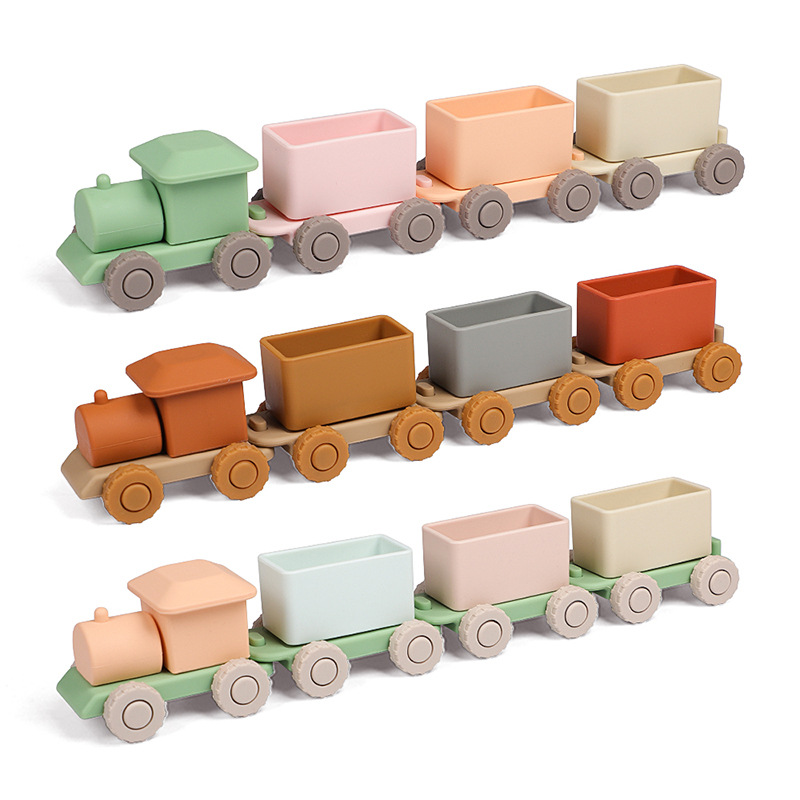
Introduction: The Toy Box Problem
Every parent knows the scenario.
You walk into a baby store, optimistic and slightly overwhelmed. Rows upon rows of plastic toys promise to “stimulate development,” “encourage crawling,” “build hand-eye coordination.” They come in screaming primary colors. They require batteries. They make sounds that haunt your dreams.
You buy a few. You bring them home. Your baby chews on the box, ignores the toy, and crawls toward the dog’s water bowl instead.
Three weeks later, the toy is in the donation pile. Or worse – still on the floor, missing a wheel, covered in dried drool, and making a weird rattling sound.
Here is the problem: most baby toys are designed to impress adults, not serve babies.
They are too complicated. Too fragile. Too rigid. Made from materials you would not want near your child’s mouth – even though your child will absolutely put them in their mouth.
And then, almost as if the universe heard the collective sigh of exhausted parents everywhere, a new kind of toy emerged.
The Food-Grade Silicone Stackable Train.
No batteries. No flashing lights. No tiny parts that disappear under the couch forever.
Just a train. A beautiful, simple, gloriously well-designed train made from the safest material on Earth. A train that rolls. A train that stacks. A train that comes apart and goes back together. A train that holds snacks. A train that grows with your child from the first grab to the first “choo-choo.”
This is the story of that train. And why it might be the only toy you actually need for the first two years.
Chapter One: What Is the Silicone Stackable Train – And Why Does It Look Different?
At first glance, the Silicone Train Toy seems almost too simple.
It is a train. A classic, chunky, rounded train with wheels that actually roll. But unlike the wooden trains of your childhood (which were lovely but splinter-prone and heavy) or the plastic trains of the 2000s (which cracked, faded, and smelled like a factory), this train is made from 100% food-grade silicone.
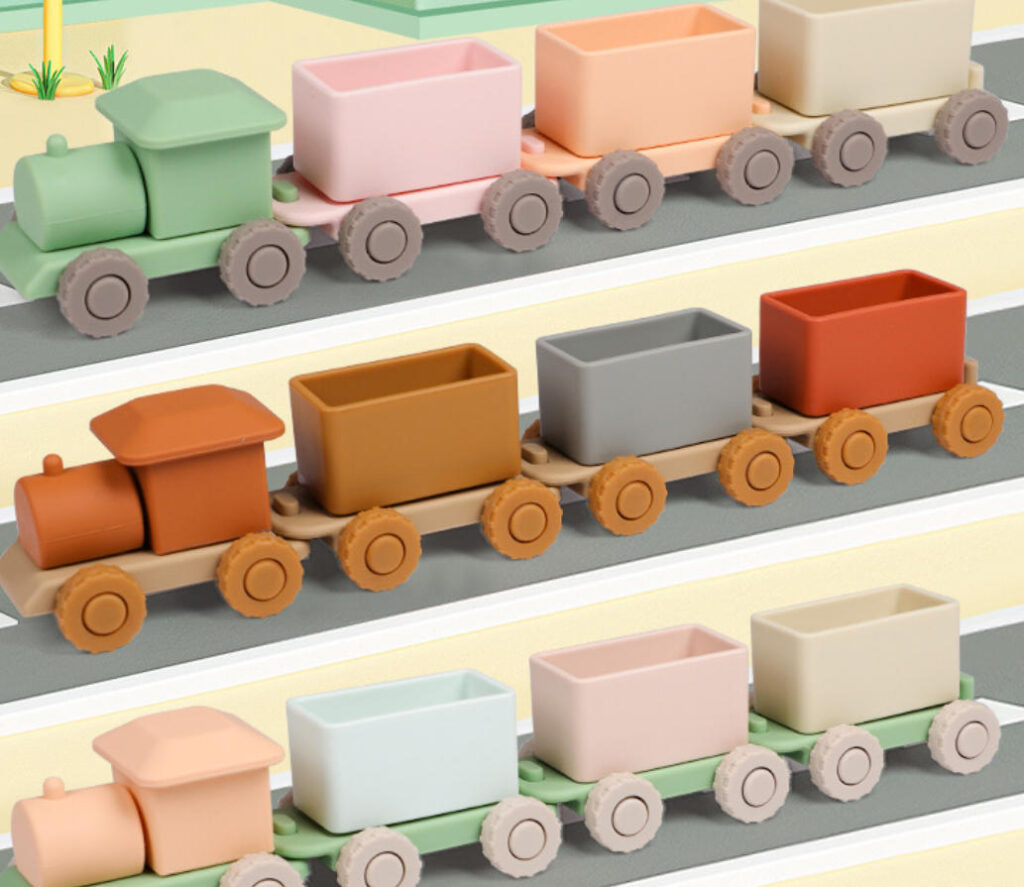
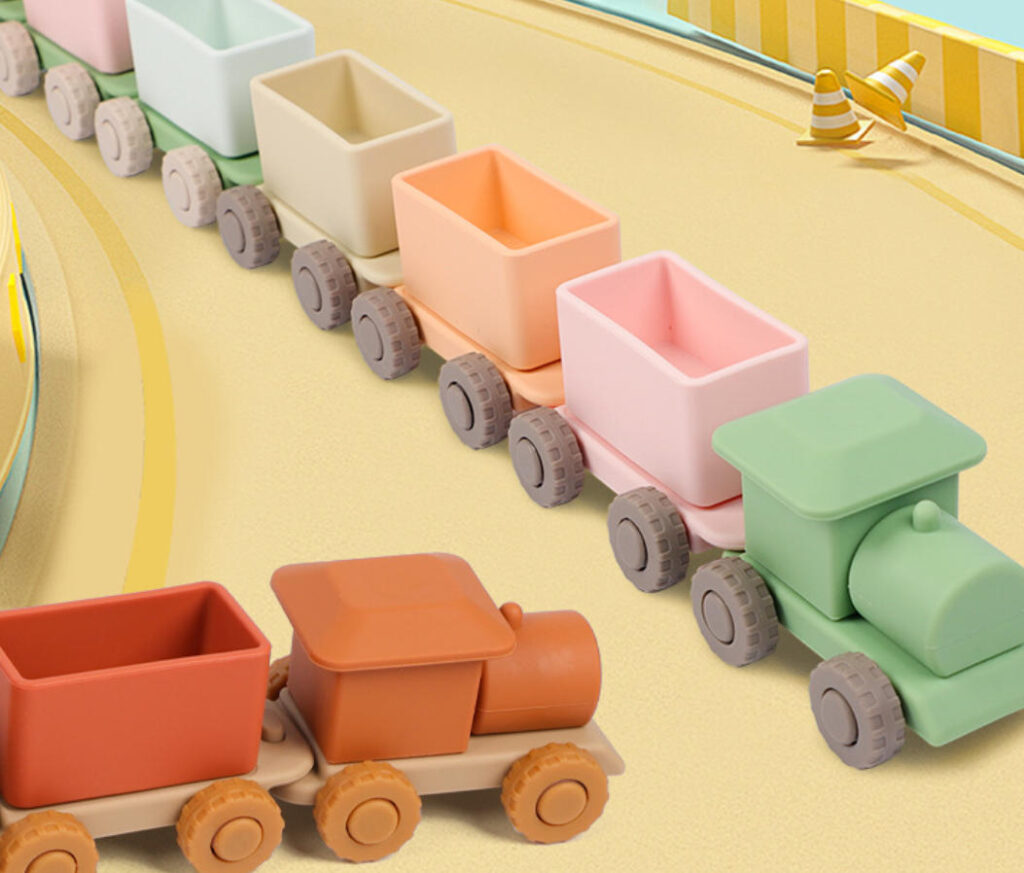
Available in three soft, modern colors:
- Rose Gold (土豪金) – Warm, elegant, surprisingly gender-neutral
- Pink (粉色) – Soft, gentle, not the aggressive “baby girl pink” of the past
- Green (绿色) – Calm, natural, easy on the eyes
But the color is just the beginning.
The train consists of individual cars (车厢) that can be:
- Stacked vertically (like a nesting or building toy)
- Connected horizontally (like a traditional train)
- Separated into single cars (for sharing between multiple children)
- Extended infinitely (buy multiple sets and connect them all)
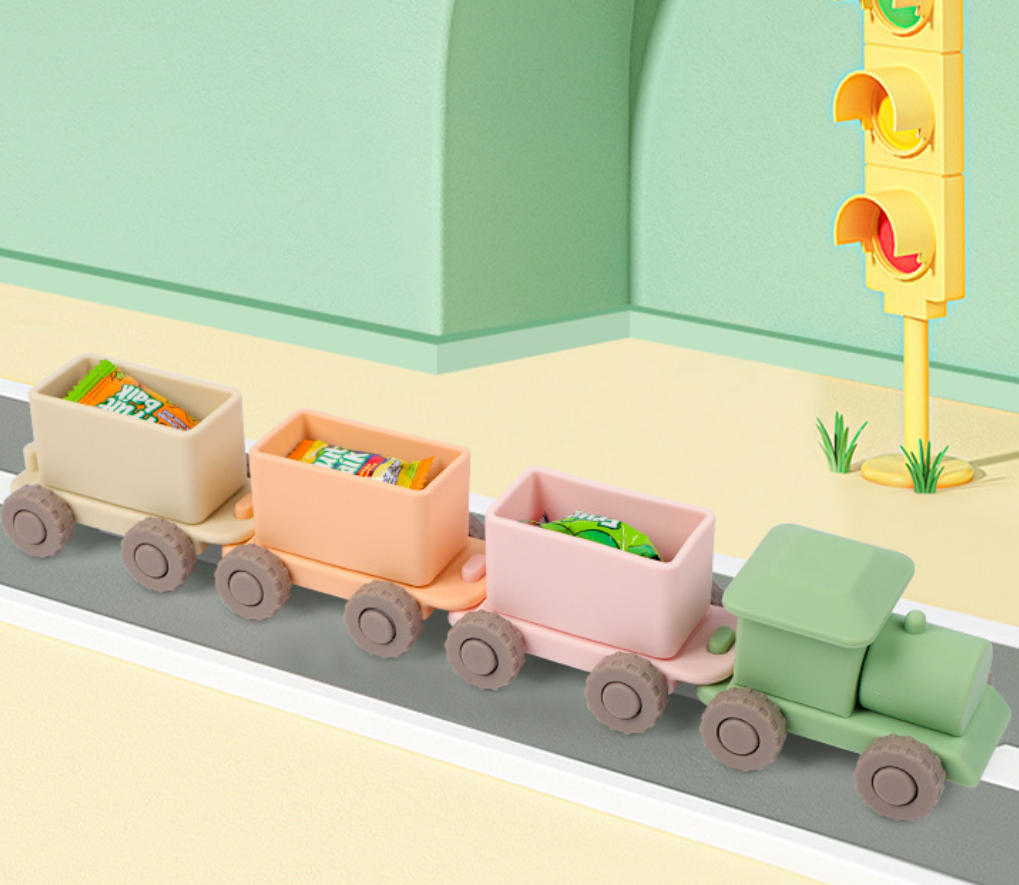
- Filled with small snacks (the cars are hollow – perfect for hiding a few puffs or teething crackers)
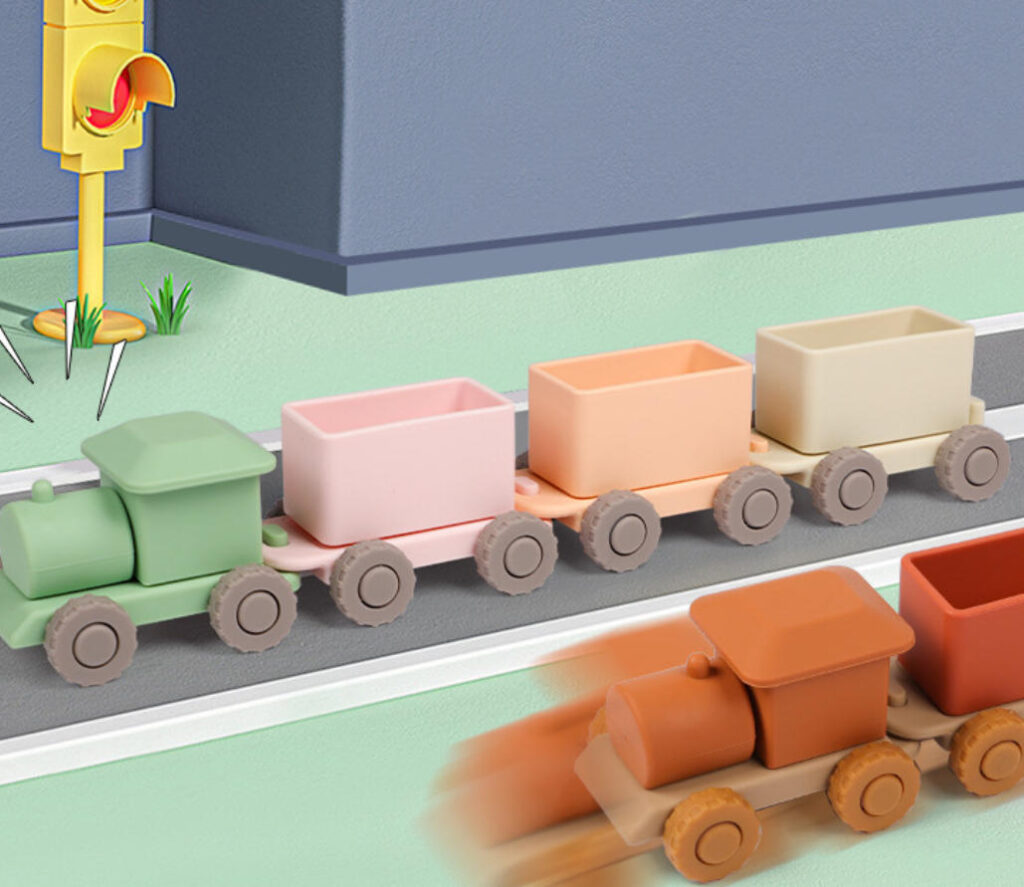
The wheels are movable (活动式车轮) – not decorative. A gentle push sends the train gliding across the floor. No batteries. No winding. No buttons. Just friction and physics and the pure joy of motion.
And because the entire thing is made from food-grade silicone, you can:
- Let your baby chew on it (they will)
- Run it through the dishwasher (yes, really)
- Boil it to sterilize it (99.9% germ elimination)
- Leave it in a hot car without warping (unlike plastic)
- Drop it on tile floors without breaking (unlike ceramic or wood)
This is not a toy designed to be looked at. This is a toy designed to be lived with.
Chapter Two: The Science of Simple Toys – Why “Boring” Is Actually Brilliant
Here is a counterintuitive truth that child development experts have known for decades:
The simpler the toy, the more the child learns.
A toy that does everything – lights up, sings songs, talks, moves on its own – teaches the child one thing: passive observation. The baby watches. The toy performs. The baby’s brain does very little work.
A toy that does almost nothing – a set of blocks, a ball, a simple train – teaches the child everything else. Cause and effect (“When I push this, it moves”). Problem-solving (“How do these two cars connect?”). Fine motor skills (“I need to line up these pegs”). Creativity (“What if the train is also a tower?”). Persistence (“It fell over. I will try again.”).
The Silicone Stackable Train is the second kind of toy.
It does not have a single battery. It does not play a single note. It does not light up or talk or transform on its own.
But watch a ten-month-old interact with it.
First, they will grab a single car. They will mouth it (silicone is perfect for teething – soft enough to soothe, firm enough to provide resistance). They will shake it. They will drop it. They will watch you pick it up.
Then, they will discover the wheels. A push. A roll. A face-splitting grin. I did that.
Then, they will try to stack two cars. It falls. They try again. It falls again. They try a third time, and this time, it stays. I solved it.
Then, they will connect the cars into a train. They will push it across the floor. They will chase it. They will laugh.
Then, they will take it apart again. Because taking apart is just as important as putting together.
Then, they will find a stray Cheerio and put it inside the car. A tiny hidden treasure. A secret compartment. Now the train is not just a train – it is a treasure box on wheels.
All of this happens without a single instruction manual. Without a parent hovering and correcting. Without frustration or boredom.
Just learning. Pure, joyful, self-directed learning.
Chapter Three: Food-Grade Silicone – The Only Material You Should Trust Near Your Baby’s Mouth
Let us talk about materials, because materials matter more than almost anything else in a baby toy.
The problem with plastic.
Most plastic baby toys are made from ABS, PP, or PVC. Even BPA-free plastics can leach other endocrine disruptors (phthalates, BPS, BPF) when heated, chewed, or simply aged. A baby who mouths a plastic toy for hours a day is exposed to low levels of these chemicals. Is it dangerous? Maybe. Maybe not. But why take the risk?
The problem with wood.
Wooden toys are beautiful. They are also porous. A wooden toy that has been chewed can absorb saliva, bacteria, and food particles. You cannot boil wood. You cannot put wood in the dishwasher. Over time, wooden toys crack, splinter, and become unsanitary.
The problem with fabric.
Fabric toys (plush, cloth books) are soft and comforting. They are also impossible to fully sterilize. A fabric toy that goes from the floor to the mouth to the diaper bag and back to the floor is a bacteria transport system.
The solution: food-grade silicone.
Silicone is:
- Non-toxic (0异味, 0荧光剂, 0有害物 – 0 odor, 0 fluorescent agents, 0 harmful substances)
- Heat-resistant (boil it, bake it, dishwasher it)
- Cold-resistant (freeze it for teething relief)
- Non-porous (bacteria has nowhere to hide)
- Soft yet durable (chew it, drop it, step on it – it bounces back)
- Easy to clean (soap and water, or a quick boil)
The Silicone Stackable Train is made from premium food-grade silicone, certified BPA-free, phthalate-free, and PVC-free. It has no smell (even fresh out of the package). It has no sharp edges. It has no small parts that can detach (the wheels are securely embedded).
You can hand it to a two-month-old baby (supervised, of course) and watch them mouth it safely. You can give it to a two-year-old toddler who is deep in the “throw everything” phase, and it will not break. You can boil it after a particularly messy play session involving yogurt or mud.
And at the end of the day, you can pop it in the dishwasher and go to bed.
Chapter Four: The Many Ways to Play – A Developmental Roadmap from 0 to 2 Years
One of the most brilliant things about the Silicone Stackable Train is that it grows with your child. It is not a “use it for three months and outgrow it” toy. It is a companion.
0–4 months: Visual tracking and early grasping.
At this age, babies cannot sit up or crawl. But they can see high-contrast objects and begin to reach. Lay the train cars on a dark blanket. The soft rose gold, pink, or green stands out beautifully against most surfaces. Your baby will track the train with their eyes. They will eventually try to bat at it. Success.
4–8 months: Teething, grasping, and shaking.
Now the mouthing begins in earnest. The silicone cars are perfect for sore gums. The texture provides just enough resistance. The size is large enough that they cannot swallow any part. They will shake the cars (no rattles inside – but the soft thud of silicone on silicone is satisfying in its own way). They will transfer cars from hand to hand. Bilateral coordination is developing.
8–12 months: Rolling, chasing, and cause-and-effect.
The movable wheels change everything. The first time your baby pushes the train and watches it glide away, a neural connection fires: I caused that. They will push it again. And again. And again. They will crawl after it. They will try to stop it with their hands. They are learning physics – force, motion, friction – without knowing the words for it.
12–18 months: Stacking, connecting, and problem-solving.
Now the train becomes a construction toy. Your toddler will figure out how the cars connect (simple pegs and holes – frustration-free design). They will stack them vertically to build a tower. They will knock it down (important – destruction is learning too). They will connect two cars, then three, then a long line across the living room. They are learning sequencing, planning, and spatial reasoning.
18–24 months: Sharing, storytelling, and imaginary play.
The train is now a social object. If you have siblings or playdates, each child can take one car. They learn to share – not because you tell them to, but because the toy is designed to be divided. They will push trains toward each other. They will make “choo-choo” sounds (language development!). They will fill the cars with “passengers” (a doll, a block, a snack) and tell stories about where the train is going. Pretend play begins. Imagination explodes.
Beyond 2 years: Infinite expansion.
The train does not stop being fun at age two. With multiple sets (available for wholesale), you can create an entire railway. Connect ten cars. Twenty cars. Build a train that stretches across the playroom. The only limit is your budget and your floor space.
Chapter Five: The Sharing Feature – Why Removable Cars Are Genius
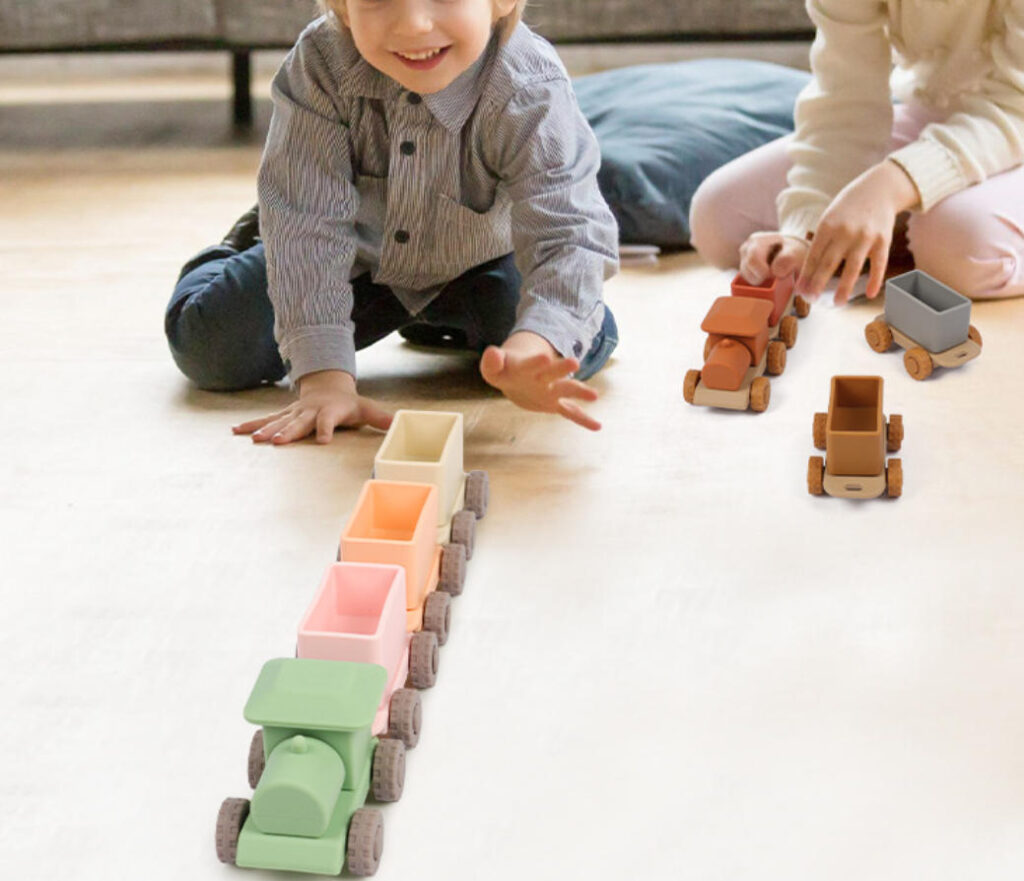
One of the most overlooked features of the Silicone Stackable Train is the removable car design (车箱可分离) .
Most train toys are fixed. You buy a train with a specific number of cars, and that is what you get. If two children want to play with the train at the same time? Conflict. Tears. Negotiation.
The Silicone Stackable Train solves this elegantly.
Each car is a separate unit. They connect easily (pegs and holes – no tools, no frustration). But they also disconnect just as easily.
So when two children want to play? One takes the pink car. One takes the green car. They can play side by side, each pushing their own train. Or they can trade. Or they can connect their cars into one longer train, then separate again.
The toy teaches sharing by design, not by lecture. There is no “you have to take turns” argument because both children can play at the same time with their own piece.
This is especially useful for:
- Daycares and preschools (multiple children, one toy, no fighting)
- Siblings (the older child can “lead” the train, the younger can “follow”)
- Playdates (each guest gets their own car – instant icebreaker)
- Wholesale buyers (classrooms can purchase one set per child and connect them all into a mega-train)
And because you can buy additional cars (mix and match colors), the train can grow to accommodate any number of children. One classroom. Thirty children. Thirty cars. One enormous silicone train winding around the room.
Chapter Six: The Snack Compartment – Because Everything Is Better with Treats
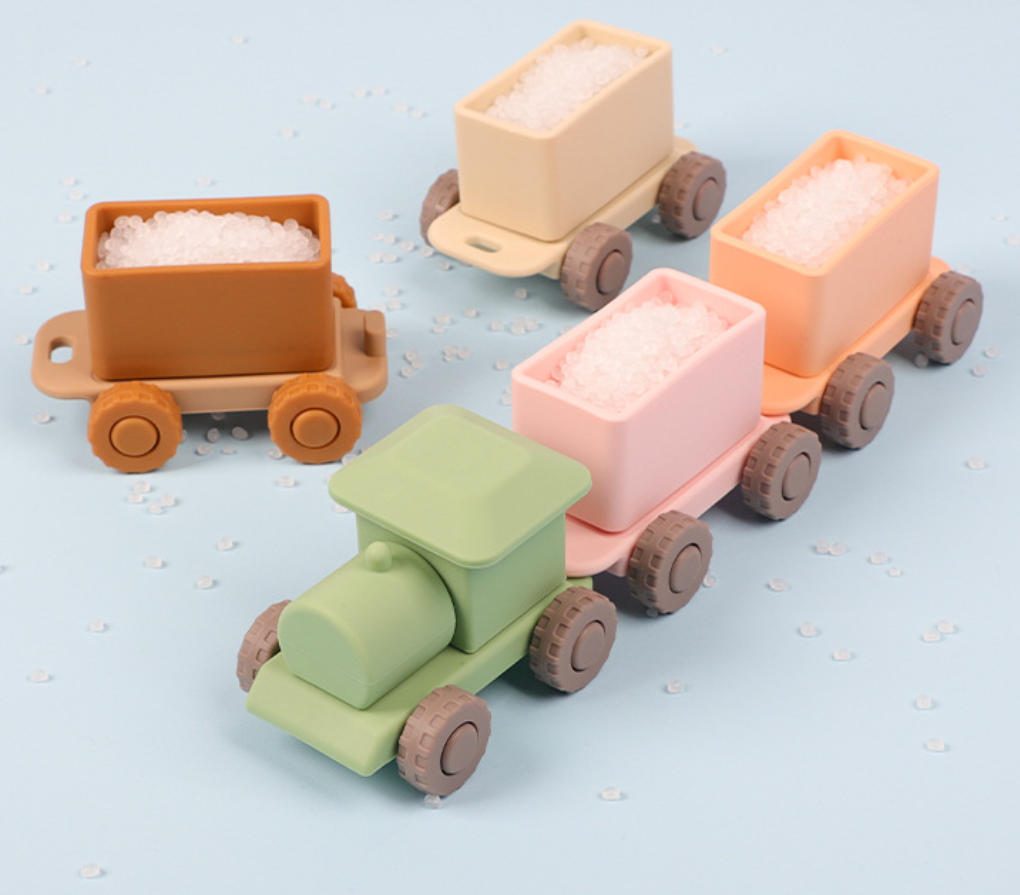
Here is a detail that parents particularly love: the cars are hollow (可装小零食) .
Not completely hollow – the wheels and connectors take up some space. But the main body of each car is empty. You can lift the top (it stays attached by a silicone hinge – no lost pieces) and place small items inside.
What kind of items?
- Teething crackers (a surprise snack during playtime)
- Puffs or yogurt drops (motivation for crawling – place a treat inside, push the train a few feet away, and watch your baby crawl after it)
- Small toys (a tiny block, a rubber duck, a doll accessory)
- Treasures (a pretty rock, a flower petal, a “special” found object)
- Notes (for older siblings or parents – hide a little love note inside)
This turns the train into a treasure hunt toy. Hide a treat, connect the cars, push the train across the room, and let your child discover the surprise. Or let them fill the train themselves – packing and unpacking objects is a developmental skill (object permanence, fine motor control, categorization).
For parents, the snack compartment also solves a practical problem: where to put the half-eaten teething cracker when your baby is done with it? Inside the train. Close the top. The mess is contained.
Chapter Seven: The Inertia Glide – No Batteries, No Friction, No Tears
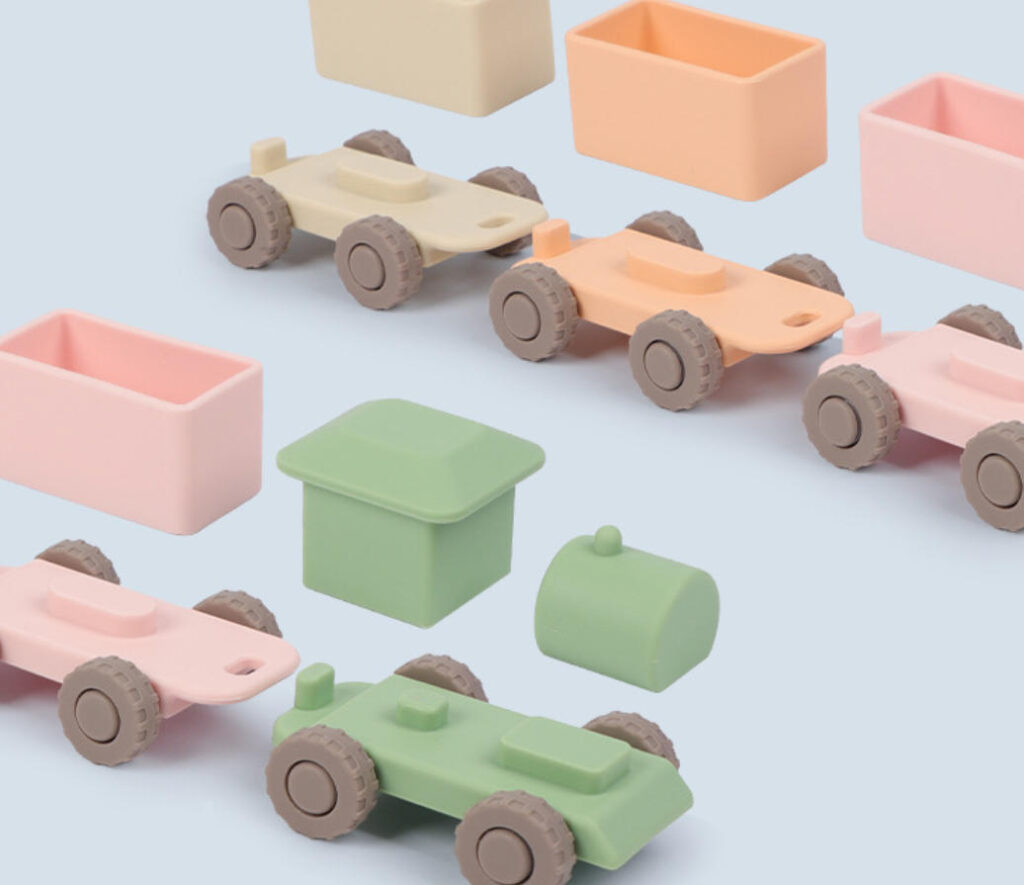
The wheels deserve their own chapter.
The Silicone Stackable Train features smooth-rolling wheels (活动式车轮) that are neither too loose (spinning wildly without moving forward) nor too tight (requiring Herculean effort to roll). They are calibrated for baby hands.
A gentle push – even from a six-month-old who has not yet developed fine motor control – sends the train gliding across most surfaces: carpet, hardwood, tile, a play mat, even grass (short grass only – long grass will slow it down).
This is not a “pull back and release” friction toy. There is no spring mechanism. There is nothing to break. It is simple: push, roll, stop. Push again.
Why does this matter? Because babies learn through repetition. A toy that requires a specific, complex action (pull back with exactly the right amount of force, release at the perfect angle, watch it zoom across the room) is frustrating for a baby. They do not have the motor control.
A toy that responds to any push, at any angle, with any amount of force? That is accessible. Your baby succeeds every time. And success breeds confidence. And confidence breeds more play. And more play breeds development.
The wheels are also non-removable (safely embedded in the silicone). You do not have to worry about a wheel coming off and becoming a choking hazard. This is a toy you can hand to a baby and trust.
Chapter Eight: OEM & Wholesale – For Businesses That Want the Best

The Silicone Stackable Train is not just for individual parents. It is designed for wholesale, cross-border e-commerce, and custom manufacturing.
KPOPDE (the manufacturer, based in Guangdong Province, China) offers:
- ODM & OEM customization – Put your brand logo on the train. Create custom colors. Adjust the packaging. Develop a completely new design based on your specifications. The factory is experienced and flexible.
- Factory-direct pricing – No middlemen. No markups. Whether you are a small boutique or a large retailer, you get wholesale pricing that allows healthy margins.
- Export-ready – The factory has experience with cross-border shipping, customs documentation, and international quality standards.
- Audit-ready – The factory supports buyer audits (验厂). If you need to verify ethical manufacturing, quality control processes, or production capacity, they welcome inspections.
- Bulk packaging options – Choose from:
- OPP bags (individual retail-ready packaging)
- White boxes (premium presentation)
- Custom packaging (design your own box)
- Vacuum packaging (for shipping efficiency)
- Low minimum order quantities for custom orders – Because they understand that small businesses need flexibility.
Whether you are an Amazon FBA seller looking for a winning product, a brick-and-mortar toy store seeking exclusive inventory, or a daycare chain wanting branded toys for your classrooms, the Silicone Stackable Train is a proven seller.
Why it sells:
- Safe (food-grade silicone – no liability nightmares)
- Durable (no returns due to breakage)
- Developmental (parents will pay a premium for toys that actually teach)
- Beautiful (shelf appeal matters)
- Unique (not another plastic toy from a big box store)
Chapter Nine: Care and Cleaning – So Easy You Will Do It Every Day

Let us end the chapter on maintenance with a simple truth: you cannot ruin this train.
Seriously.
- Boil it. Put the train cars in a pot of boiling water for 3–5 minutes. 99.9% of bacteria eliminated. The silicone will not melt, warp, or degrade.
- Dishwasher it. Top rack. Any cycle. The train comes out sparkling.
- Soap and water. Warm water, mild dish soap, a soft sponge. Rinse. Dry. Done.
- Wipe it. A baby wipe, a disinfectant wipe (allow to dry before giving to baby), even a damp paper towel. Surface clean in seconds.
- Freeze it. For teething relief, pop a car in the freezer for 20 minutes. The silicone becomes cold but not dangerously hard. Your baby will gnaw on it happily.
What not to do:
- Do not use abrasive cleaners or scrub brushes (they may scratch the silicone – scratches are cosmetic only, still safe)
- Do not microwave the train (silicone is microwave-safe, but the train has no reason to go in the microwave)
- Do not expose to open flame (obvious, but worth stating)
Compare this to wooden toys (do not get them wet, do not leave them in the sun, hope they do not crack) or plastic toys (hand-wash only, no high heat, replace when scratched). The silicone train is practically indestructible.
Chapter Ten: The Final Word – Why This Train Deserves a Spot in Every Nursery

You have read over two thousand words.
You have learned about food-grade silicone and stackable cars. About removable snack compartments and smooth-rolling wheels. About developmental benefits from 0 to 2 years and beyond. About wholesale options and export logistics.
But here is the bottom line:
This train is safe. It is simple. It works.
Your baby will love it not because it lights up or sings or connects to an app. Your baby will love it because it responds to them. Push and it rolls. Stack and it builds. Connect and it becomes a train. Disconnect and it becomes something to share.
It will survive teething. It will survive being thrown. It will survive the dishwasher and the freezer and the bottom of the diaper bag.
And one day, years from now, when your child has outgrown it, you will look at the train – still soft, still beautiful, still intact – and you will remember the crawling, the stacking, the first “choo-choo.”
And you will be glad you chose something that lasted.