 silicone@silic0ne.com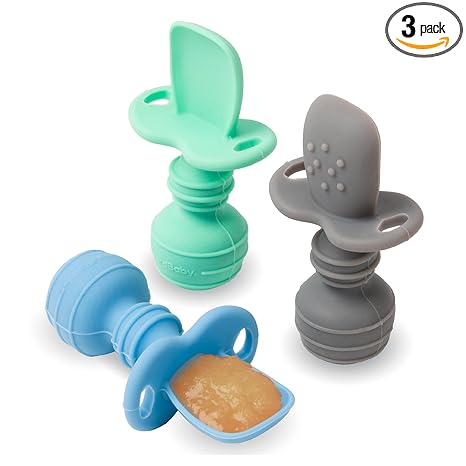
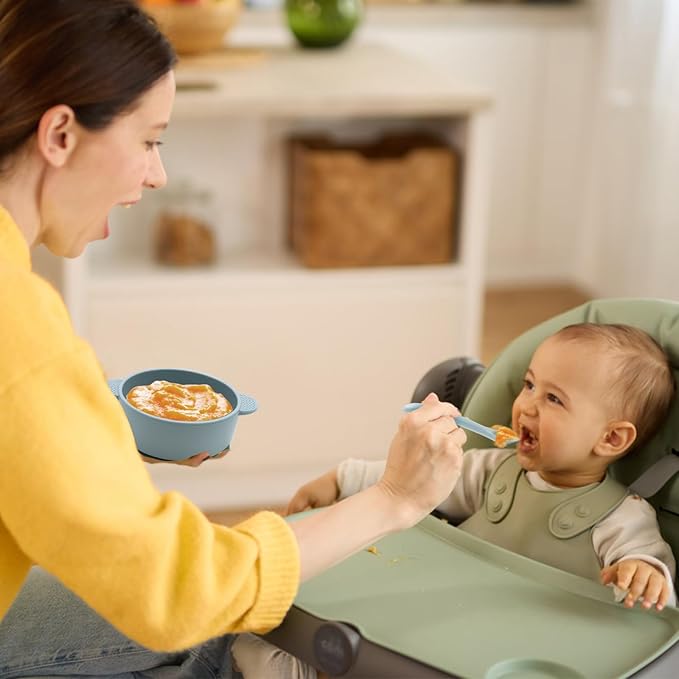
You are sitting across from your 7-month-old. The high chair tray is a Jackson Pollock of sweet potato puree. Your child lunges for the spoon in your hand, misses, and grabs a fistful of oatmeal instead. You hesitate. Do you keep feeding them? Do you let them try on their own? And the question that echoes in every parent’s mind: What if they choke?
Baby-led weaning (BLW) is one of the most rewarding parenting journeys – and one of the most anxiety-provoking. The philosophy is beautiful: trust your baby to self-feed, explore textures, and develop motor skills at their own pace. But the reality is messy, loud, and sometimes scary.
That is why the Self-Feeding Spoon with Anti-Choke Barrier exists. Not just as a utensil, but as a permission slip. Permission to step back. Permission to let your baby explore. Permission to enjoy your own dinner while it is still warm.
Let’s talk about how three small spoons in blue, gray, and mint can change the entire atmosphere of your family table.
Empower Self-Feeding: Tiny Hands, Giant Leaps

The journey from puree to pincer grasp is measured in small victories. The first time a baby successfully brings a loaded spoon to their mouth is a moment of pure magic – for them and for you.
But most spoons are designed for adult hands. Long handles. Heavy heads. Slippery surfaces. They set babies up to fail.
UpwardBaby (the brand behind this set) spent months studying how babies actually hold things. What did they discover? Babies don’t grip with their fingertips; they grip with their whole palm. They don’t rotate their wrists smoothly; they pivot from the shoulder. And they absolutely cannot manage a spoon that is longer than their forearm.
These spoons feature ergonomic handles that are short, chunky, and textured. Short enough that the center of gravity is close to the baby’s fist. Textured enough that drool, puree, and yogurt won’t turn the handle into a slip-and-slide.
The result? A baby who drops the spoon less often. A baby who gets frustrated less quickly. A baby who learns, within days, that this tool helps me eat.
Independence is not a switch that flips at age two. It is built meal by meal, spoonful by spoonful. Every successful scoop is a brick in the foundation of self-confidence. By giving your baby a spoon that actually works for their physiology, you are telling them: I believe you can do this.
And when they look up at you with orange-smeared cheeks and a triumphant grin, you will know it was worth it.
Prioritize Safety: Beyond “BPA-Free”
Let’s get specific about materials, because vague promises don’t belong near a baby’s mouth.
This spoon is made of 100% food-grade silicone. That is not a marketing buzzword. It is a material standard. Here is what it guarantees:
- No BPA – Bisphenol-A is an endocrine disruptor linked to developmental issues. Not here.
- No PVC – Polyvinyl chloride off-gasses toxic chemicals during production. Not here.
- No Lead – Lead has no place in a child’s body. Not here.
- No Phthalates – These plastic softeners are banned in children’s toys for good reason. Not here.
But let’s talk about what silicone does have. It has heat resistance (sterilizable in boiling water). It has softness (gentle on emerging teeth). It has durability (won’t crack or splinter like plastic). And it has a non-porous surface that doesn’t harbor bacteria.
When you hand your baby this spoon, you are not hoping it’s safe. You are knowing it’s safe.
For parents transitioning their infant to solids – that vulnerable, exciting, terrifying window between 6 and 12 months – this certainty is priceless. You cannot see the chemicals in a cheap plastic spoon. You cannot taste the lead. But you can feel the difference when you hold a product made with genuine care.
Support Oral Development: Massage Gums, Build Skills

Teething is brutal. For everyone. The baby is miserable. The parents are sleep-deprived. And suddenly, that carefully prepared puree is being rejected because everything hurts.
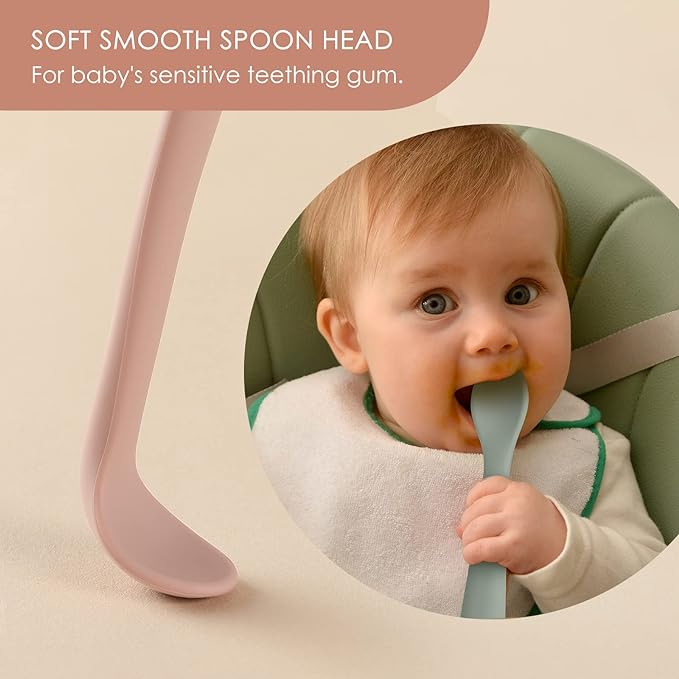
The textured tip of this spoon serves a dual purpose. First, it helps grip puree – small divots hold onto yogurt and applesauce better than a smooth surface. But second, and more importantly, it massages sore gums.
When your baby inevitably chews on the spoon (and they will – oh, they will), those soft textures stimulate the gums. This increases blood flow, which reduces inflammation. It provides counter-pressure, which soothes the ache of an erupting tooth. And it gives the baby a safe, satisfying object to bite down on.
This is not a distraction from eating. This is part of eating. Oral development – the strength of the tongue, the coordination of the jaw, the mapping of the mouth – happens through chewing and mouthing. By making the spoon a pleasurable object to gnaw on, we keep the baby engaged at the table longer. And longer engagement means more practice with self-feeding.
The grippy design also withstands enthusiastic bites. Have you ever seen a baby chomp down on a plastic spoon? It cracks. Metal spoon? It dents teeth (and sounds horrific). Silicone gives gently, then springs back. It survives the teething tornado.
Prevent Choking Hazards: The Anti-Choke Barrier That Changes Everything
Now we arrive at the feature that makes this spoon different from every other silicone spoon on the market: the advanced choke barrier.
Here is a frightening statistic: The gag reflex in infants is located much further forward on the tongue than in adults – roughly at the middle of the tongue rather than the back. This means that a spoon inserted just two inches into a baby’s mouth can trigger a gag, and if the baby panics, that gag can become a choke.
Most “baby spoons” are simply smaller versions of adult spoons. They have no protection against deep insertion. Parents are left hovering, ready to perform the baby Heimlich at any moment.
This spoon features a built-in, integrated choke barrier – a gentle, rounded guard that sits just behind the spoon head. When the baby puts the spoon in their mouth, the barrier contacts the lips. To go further, they would have to actively force it. And because the barrier is soft silicone, it is uncomfortable to force. The baby naturally stops at the safe depth.
But let’s be clear: This is not a pacifier shield. It does not restrict breathing or make the spoon hard to use. It simply provides a physical stop that gives you a few critical millimeters of safety.
For babies aged 6-12 months, this barrier is a game-changer. You no longer have to watch like a hawk. You can sit back slightly, eat your own meal, and trust the engineering.
And here is the beautiful part: As your child grows (12+ months), their gag reflex migrates backward. Their motor skills improve. They learn to self-regulate. At that point, you may transition to a spoon without a barrier. But for the first six months of weaning, this spoon allows you to be present without being paralyzed by fear.
Boosting parent confidence is not a soft benefit. It is the core benefit. When you are confident, you relax. When you relax, your baby relaxes. When everyone relaxes, mealtime becomes joyful rather than stressful.
Stylish and Functional: Because Aesthetic Matters
We have all seen the baby aisle at big box stores. It is a sea of neon plastic, cartoon characters, and colors that hurt your eyes. The implicit message is that baby products don’t need to be beautiful – they just need to be cheap.
But you live with these products. They sit on your kitchen counter. They go into your diaper bag. They appear in every family photo from 6 months to 2 years.
This set comes in Gray, Blue, and Mint – a modern, unisex palette that looks as good on a farmhouse table as it does in a city apartment. The matte silicone finish resists fingerprints. The colors are soft without being pastel, bold without being garish.
These spoons photograph beautifully (hello, Instagram-worthy weaning moments). They match a variety of high chairs, plates, and bibs. And because they are stylish, you will actually want to keep them on the counter rather than shoving them into a drawer.
Functionality and style are not opposites. They are partners. A spoon that looks good is a spoon you reach for first. A spoon you reach for first is a spoon that gets used. And a spoon that gets used is a spoon that helps your baby learn.
Home & Travel: The Versatility You Need
Let’s talk about logistics. A spoon that lives only in the kitchen is only half useful. Your baby eats at restaurants, at grandma’s house, at daycare, on airplanes, in the car (please don’t feed in a moving car, but we know you’ve considered it).
This set of three spoons is designed for home and travel:
- At home: Keep one in the kitchen drawer, one in the diaper bag, and one in the dishwasher. Rotation ensures you always have a clean spoon.
- Travel: The short handle fits into any utensil case or even a Ziploc bag. Because the spoon is one solid piece of silicone, there are no small parts to lose.
- Daycare: Label them with a permanent marker (it washes off silicone eventually, but you can re-label). Send all three on Monday, get them back on Friday.
The spoons are dishwasher safe (top rack) and equally happy in a sink of hot soapy water. They dry quickly because silicone is non-absorbent. And they don’t retain food odors or stains – even after a curry or a beetroot puree.
Answering Your Hidden Questions
“Will my baby reject the choke barrier?”
Some babies initially try to push past it, but the soft resistance is not painful. Within a few meals, they learn to accept the depth limit. In fact, many babies use the barrier as a lip reference point – they know exactly where to stop.
“Is silicone really safe for chewing?”
Yes, when it is food-grade silicone. Low-quality silicone may contain fillers, but our 100% food-grade silicone is inert, non-toxic, and tested for safety. It is the same material used in medical tubing and baking mats.
“How do I clean the textured tip?”
The texture is gentle enough to release food easily. A quick scrub with a bottle brush or even your thumb under running water does the job. For deep cleaning, boil for 5 minutes or place in the dishwasher.
“My baby is 14 months. Is this spoon too babyish?”
For a confident self-feeder, you may want a longer, more advanced spoon. But for a child who is still learning, or who has sensory aversions, this spoon remains useful. Many toddlers prefer the soft silicone and the security of the barrier.
The First Stage: Why 6 Months Is the Right Time
The transition to solids is not a race. Some babies start purees at 4 months (with doctor approval). Most begin baby-led weaning around 6 months, when they can sit upright and have lost the tongue-thrust reflex.
This spoon is labeled first stage for a reason. It is for the earliest attempts: the open-mouthed stares, the tentative licks, the accidental face-plants into the bowl. It is for parents who are still learning their baby’s cues and need one less thing to worry about.
By 9 months, most babies using this spoon will be able to scoop independently (though messily). By 12 months, they will be pros – and you will be nostalgic for the days when they wore more food than they ate.
The Ultimate Baby-Led Weaning Supply
Baby-led weaning has a passionate community, and for good reason. Studies suggest that BLW babies may have healthier body weights, less picky eating, and better oral motor development than spoon-fed peers. But BLW requires specific tools: soft foods cut into sticks, suction bowls, and yes, self-feeding spoons.
This 3-pack is the perfect starter set for BLW families. Use the spoons for:
- Mashed avocado
- Thick yogurt
- Oatmeal
- Refried beans
- Mashed sweet potato
- Applesauce
- Baby-led weaning “dips” (hummus, guacamole)
And because you have three, you can use one for cooking (tasting sauces), one for eating, and one for the inevitable floor drop.
Final Thoughts: Your Seat at the Table
The most profound change that happens when you introduce self-feeding is not about the baby. It is about you.
For months, you have been feeding your child – from the breast or bottle, from a spoon you control. You have been the source. And while that is beautiful, it is also exhausting. You deserve to sit at the table, to eat your own meal while it is hot, to drink your coffee without reheating it four times.
The Self-Feeding Spoon with Anti-Choke Barrier gives you back that seat. Not because you stop caring, but because you can trust. Trust the material. Trust the design. Trust the safety barrier that prevents choking. And most importantly, trust your baby.
These three spoons – in soft blue, cool gray, and fresh mint – are small objects. But they carry a big promise: Mealtime can be joyful. You can step back. Your baby will rise to the occasion.
Ready to transform your family dinners? Click below to get your 3-pack of UpwardBaby silicone spoons and start your self-feeding journey today. Your baby is waiting. And so is your dinner.