 silicone@silic0ne.com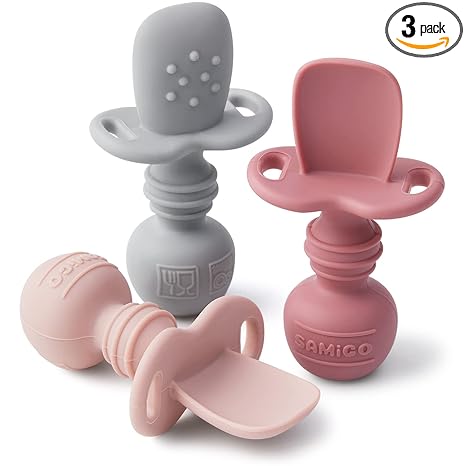
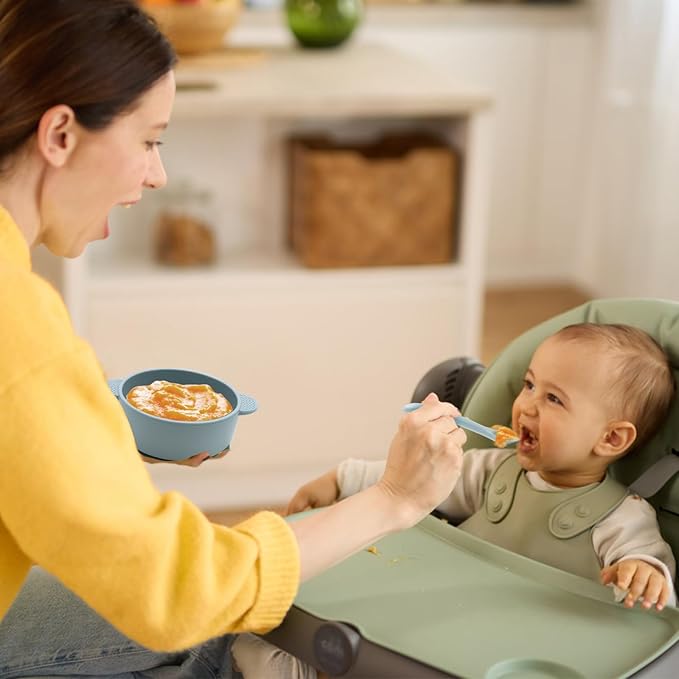
There is a moment, usually around 5:30 PM, when you find yourself holding a spoon in one hand and a squirming 7-month-old in the other. You have made a beautiful, organic, lovingly steamed sweet potato puree. You open your mouth like a baby bird, hoping for mimicry. Your baby looks at the spoon, looks at you, and then smacks it onto the floor with the precision of a tennis pro.
This is not failure. This is the first stage of Baby Led Weaning (BLW) , and it is messy, glorious, and terrifying.
For parents venturing into the world of solids, the equipment matters almost as much as the food. You wouldn’t give a new driver a Formula 1 car. So why would you give a teething 6-month-old a long, hard, metal adult spoon?
Enter the Silicone Baby Spoons Self Feeding Set. This is not just a utensil; it is a bridge. A bridge between the comfort of the breast or bottle and the independence of the high chair. A bridge between gagging and safe swallowing. A bridge between your anxiety and their joy.
Master Utensils Effortlessly: The Neurology of the Grip
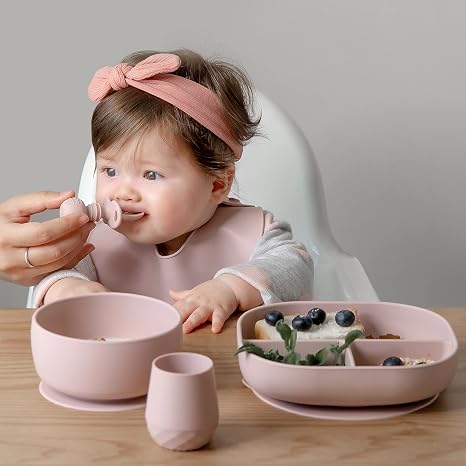
Let’s look at a baby’s hand at 6 months. It is a chubby, dimpled fist. The pincer grasp (using thumb and forefinger) hasn’t fully developed. The fine motor skills required to angle a traditional spoon into a mouth are about 18 months away.
Yet, we hand them metal spoons and expect miracles.
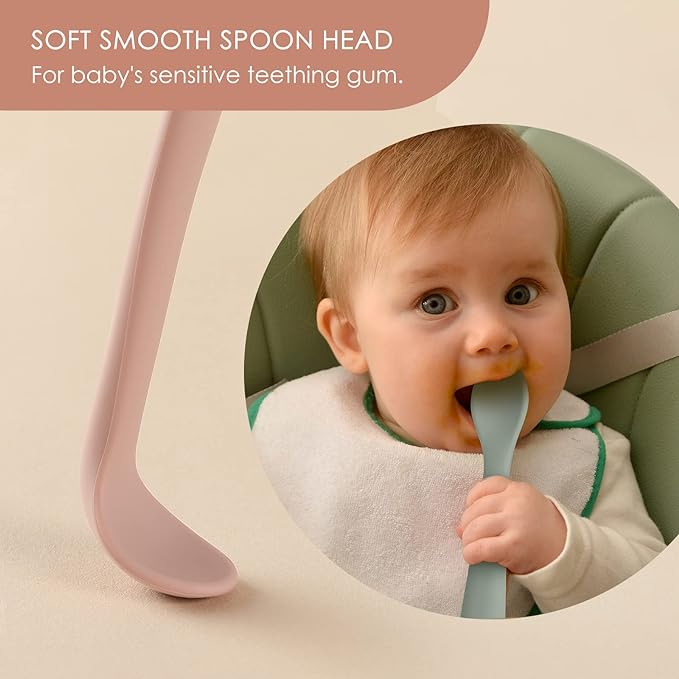
Our silicone spoons are designed specifically for the palmar grasp – that whole-hand hugging motion. The handle is stubby, not long. A long handle acts as a lever against a baby’s weak wrist. A short handle puts the food source closer to the hand, reducing the leverage and increasing control.
But we didn’t stop at length. Look at the texture. The handle is textured with gentle ridges. Why? Because wet, slippery spoons are frustrating. When a baby’s hand is covered in banana mush, a smooth handle becomes a bar of soap. The tactile grip of our silicone gives their little fingers something to hold onto. It tells their sensory system: This is mine. I have control.
Parents report that within two or three meals, their baby stops dropping the spoon and starts deliberately moving it toward their mouth. That is not magic. That is ergonomics.
Intuitively Easy to Use: Sensory Bumps and the “Chew-to-Learn” Method

Here is the secret that baby food companies don’t want you to know: Babies learn to eat by chewing on things that aren’t food.
Before a baby understands “spoon goes in mouth, food comes off,” they understand “object goes in mouth, I chew.” Our spoons embrace this reality. The spoon head features sensory bumps – tiny, soft nodules on the back of the spoon head.
Why? Because when your baby inevitably turns the spoon around and chews on the handle (they will), those bumps provide oral motor stimulation. They massage sore teething gums. They map the inside of the mouth. They teach the tongue where the spoon is.
And then, something wonderful happens. The baby realizes: When I turn this around the other way, the food is on the end.
We have essentially hacked the learning curve. By making the spoon enjoyable to chew, we keep it in the baby’s mouth longer. And the longer it is in their mouth, the faster they figure out the correct orientation. It is intuitive design that works with baby’s instincts, not against them.
Choking Is No Longer a Thing: The Built-In Stopper That Saves Lives

Let’s be honest. This is the paragraph every parent reads first. You can ignore the colors, the grip, the cleaning instructions. But you cannot ignore safety.
The number one fear of parents starting solids is choking. Not gagging (which is normal and protective), but actual airway obstruction. A baby’s gag reflex is located much further forward on the tongue than an adult’s. This means they can easily shove a spoon too far back, trigger their gag, and panic.
Most spoons on the market ignore this anatomy. They are smooth, long, and dangerous.
Our spoon features a Built-in Stopper – a gentle, rounded guard that sits just behind the spoon head. This stopper is engineered to prevent the spoon from entering the mouth beyond a safe depth. It is not sharp or uncomfortable. The baby simply feels a gentle resistance and stops.
This feature does three things:
- Prevents injury – No jabbing the soft palate or triggering a severe gag reflex.
- Builds parent confidence – You can step back and let them self-feed without hovering your hand inches from their face.
- Teaches boundaries – Babies learn, over time, how far is “far enough.”
With this spoon, “shoving it down their throat” becomes physically impossible. You can breathe. They can explore. This is the peace of mind that no amount of organic puree can buy.
Safer Silicone: The Material Manifesto

We live in a world of “greenwashing” and vague labels. “BPA-free” has become almost meaningless, as manufacturers simply swap BPA for BPS (which may be just as bad). We don’t play those games.
Our spoons are made of 100% food-grade silicone. Let’s decode what that actually means:
- BPA Free – No bisphenol-A, a known endocrine disruptor.
- PVC Free – No polyvinyl chloride, which releases toxic dioxins during manufacturing.
- Lead Free – Yes, lead has been found in cheap imported tableware. Not here.
- Phthalate Free – No phthalates, which are used to soften plastics and have been linked to reproductive issues.
But silicone offers more than just the absence of bad things. It offers positive benefits:
- Heat resistant – You can sterilize these spoons in boiling water. You cannot do that with plastic.
- Soft on gums – Unlike metal or hard plastic, silicone gives slightly under pressure. When your teething baby chomps down (and they will), they are biting a soft, forgiving material, not a rigid weapon.
- Non-porous – Bacteria cannot hide in microscopic scratches. Silicone is naturally hygienic.
- Durable – These spoons will survive the dishwasher, the freezer, the microwave, and the wrath of a toddler throwing them against the wall.
And because they are a single piece of molded silicone (no separate handles, no glued parts), there are no crevices for old food to rot. What you see is what you get.
Easy Clean-Up: The 3-Second Rule

Parents do not have time for “hand wash only.” We know this. The moment after a meal, you have a baby to clean, a high chair to scrub, a floor to sweep, and possibly a dog to thank for eating the dropped broccoli.
Our spoons are dishwasher safe (top rack) and equally happy in a sink of hot soapy water. Because they are silicone, food releases easily. Peas don’t stick. Yogurt slides off. Oatmeal doesn’t glue itself to the surface.
But let’s talk about the sterilization hack. Once a week, toss these spoons into a pot of boiling water for 5 minutes. Unlike plastic, which warps and leaches, silicone emerges pristine. You can also put them in the dishwasher’s sanitizing cycle or use a UV sterilizer. Whatever fits your flow.
And because you get a Set of 3, you can rotate. One in the baby’s mouth, one in the dishwasher, one in the diaper bag. No waiting. No panic when you realize the only clean spoon is at the bottom of the sink under last night’s pasta bowl.
The Ultimate Gift: Why These Spoons Belong on Every Registry

When you attend a baby shower, what do people buy? Cute onesies that will be outgrown in three weeks. Blankets that the baby will reject. Plastic toys that require batteries.
The parents need the boring stuff. The stuff that makes daily survival possible.
A set of Silicone Baby Spoons is the gift of sanity. It says: I see you. I know you are about to enter the messy, beautiful chaos of weaning. Here is a tool that will reduce your anxiety and increase your baby’s joy.
The set comes in uniquely cute colors – not just pastel pink and blue, but modern, unisex tones like sage green, dusty rose, and slate gray. They look good on the table. They photograph well for those inevitable “first bite” Instagram posts. But more importantly, they signal thoughtfulness.
For grandparents who want to “help,” this is a perfect suggestion. For a friend who has everything, this is the thing they didn’t know they needed.
Addressing Common Concerns (Because We Read the Reviews)

Concern 1: “My baby just chews the handle and ignores the food.”
That is the point. Chewing the handle is the first step. The sensory bumps are doing their job. Within a week, they will flip it. Be patient. Put a tiny smear of puree on the spoon head, then hand it over. Curiosity will do the rest.
Concern 2: “The stopper seems bulky.”
It is designed to be exactly the width of a baby’s mouth opening. As your child grows (12+ months), you may transition to a spoon without a stopper. But for the 6-12 month window, that “bulk” is what keeps them safe. You will miss it the first time they use a regular spoon and jam it too far back.
Concern 3: “Silicone absorbs soap taste.”
This is true of low-quality silicone or when using highly perfumed detergents. Our food-grade silicone is less porous, but to be safe: use fragrance-free dish soap, or rinse thoroughly. A quick dip in boiling water resets the silicone and removes any lingering flavors.
Concern 4: “My baby refuses to let go of the spoon.”
Congratulations. You have succeeded. Attachment to the spoon means they see it as theirs. This is ownership. This is the first step toward self-feeding. Let them sleep with it. Let them wave it like a scepter. It will eventually end up on the floor. That is also fine.
The Weaning Timeline: How These Spoons Grow With Your Child
- 6-7 Months (First Tastes): Use the spoon as a pre-loader. You dip it, hand it to baby, let them mouth it. The stopper prevents deep insertion. The soft silicone protects new teeth.
- 8-10 Months (The Scoop Attempt): Baby tries to dip the spoon into the bowl. They will mostly miss. The textured handle helps them maintain grip even with messy hands.
- 11-14 Months (The Independent Eater): Your toddler can now scoop, transport, and release. The spoon is still short enough for their small hands, but durable enough for thick oatmeal and yogurt.
- 15+ Months (Transition): By now, many children are ready for metal spoons. But keep these silicone spoons in rotation for travel, daycare, or “low frustration” meals.
Final Thoughts: The Spoon That Lets You Step Back
The single greatest gift you can give your baby is the space to try. But trying requires safety. Trying requires tools that don’t fight back. Trying requires a spoon that says “I trust you” rather than “Let me do it for you.”
The Silicone Baby Spoons Self Feeding Set (3 Pack) is that trust in physical form. It is the reassurance that when you walk away from the high chair to grab a paper towel (for the inevitable floor mess), your baby is not going to hurt themselves. It is the knowledge that the material touching their mouth is free from endocrine disruptors. It is the joy of watching your 8-month-old light up because they got the spoon to their mouth by themselves.
We cannot promise that mealtime will be neat. We cannot promise they will love broccoli. But we can promise that the utensil will not be the enemy.
Make the switch today. Your baby is ready. You are ready. Let’s eat.
Click here to get your 3-pack of Silicone Baby Spoons and turn mealtime chaos into confident first bites.